

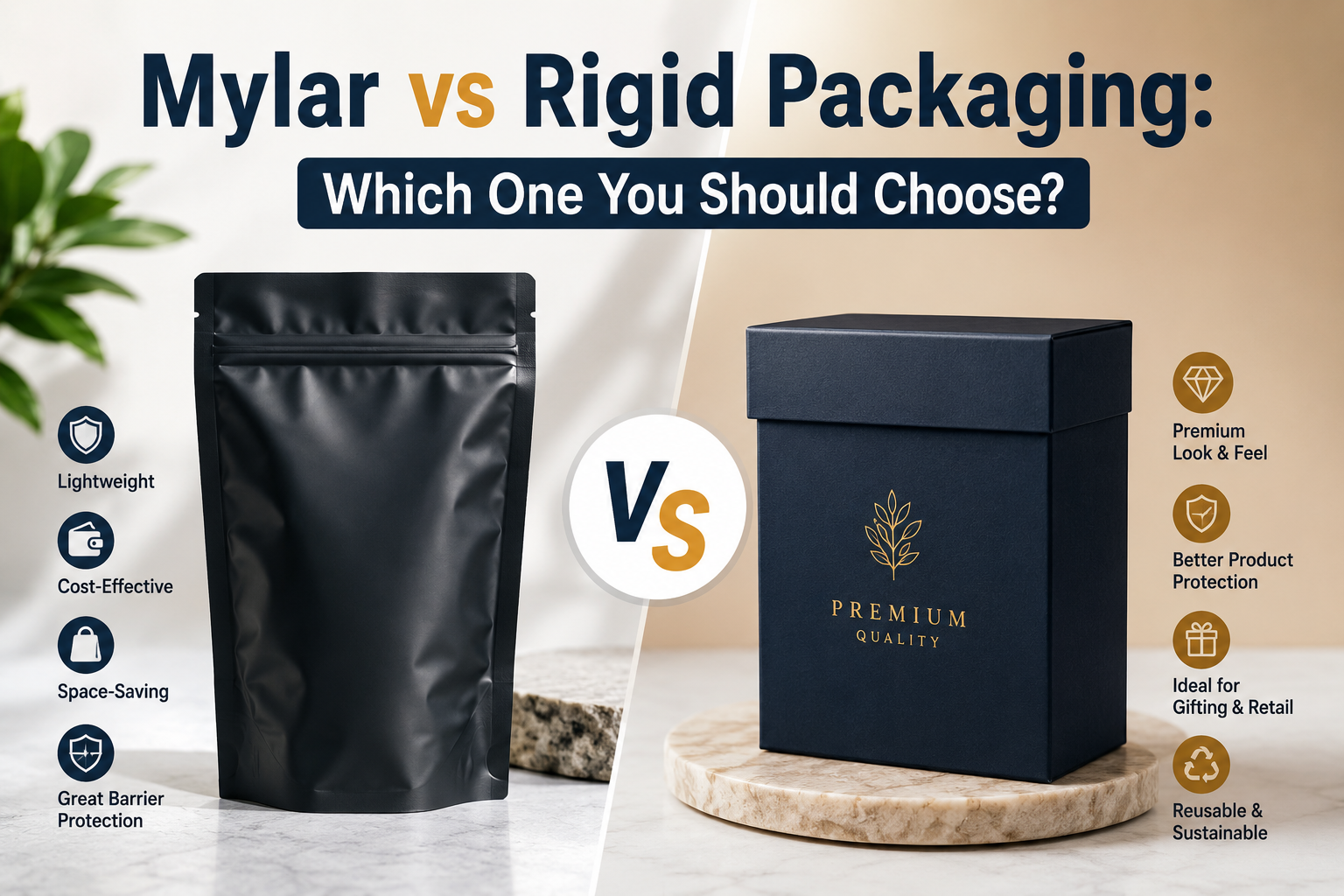
Mylar vs Rigid Packaging: Which One You Should Choose?

The Packaging Decision That Can Make or Break Your Product
Every product deserves packaging that works as hard as the product itself. But with so many options available, one of the most common — and most consequential — decisions brands face is choosing between Mylar packaging and rigid packaging.
Both are widely used across industries. Both offer compelling advantages. Yet they serve very different purposes, and choosing the wrong one can cost you in ways you might not expect — from damaged products and inflated shipping costs to a brand image that simply doesn’t connect with your target audience.
Whether you’re launching a new food product, scaling a supplement line, designing luxury cosmetics, or entering the cannabis market, this guide will walk you through everything you need to know about Mylar vs rigid packaging — so you can make a confident, informed decision.
What Is Mylar Packaging?
Mylar is a brand name for BoPET — Biaxially Oriented Polyethylene Terephthalate — a type of polyester film manufactured through a stretching process that gives it exceptional strength and barrier properties. Originally developed by DuPont in the 1950s, Mylar was first used in industrial and military applications before making its way into commercial packaging.
Today, “Mylar” is used broadly to describe flexible, multi-layer foil-based packaging used across food, pharmaceutical, and consumer goods industries.
Key Characteristics of Mylar Packaging
What makes Mylar stand out is its remarkable barrier performance. Mylar films are engineered in multiple layers — typically combining polyester, aluminum foil, and polyethylene — to create a material that:
- Blocks moisture and humidity from degrading product quality
- Shields against oxygen, preventing oxidation and spoilage
- Reflects UV light, protecting light-sensitive products
- Contains odors and aromas, critical for food and cannabis products
- Resists punctures and tears despite being thin and lightweight
These properties make Mylar one of the most effective materials for extending product shelf life — sometimes for years — without refrigeration.
Common Forms of Mylar Packaging
Mylar is available in a wide range of flexible packaging formats, including:
- Stand-up pouches — self-supporting bags with flat bottoms, ideal for retail shelves
- Flat pouches and sachets — lightweight, single-use packets for portions or samples
- Zip-lock resealable bags — consumer-friendly, reusable options for snacks and supplements
- Foil-sealed bags — airtight, tamper-evident packaging for sensitive products
- Roll stock — bulk film for automated packaging lines
Industries That Use Mylar Packaging
Mylar Bags is a go-to solution across a diverse range of sectors: snack foods, coffee and tea, pet food, dietary supplements, cannabis and hemp products, pharmaceuticals, military ration kits, and emergency preparedness supplies.
What Is Rigid Packaging?
Rigid packaging refers to any solid, non-flexible container or enclosure that maintains its shape regardless of its contents. Unlike Mylar, rigid packaging does not bend or compress. It is structured, firm, and often perceived as more premium.
Rigid packaging is made from a variety of materials, including hard plastic (PET, HDPE, PP), glass, metal (aluminum or tin), thick paperboard, and acrylic. Each material brings its own set of properties in terms of durability, weight, aesthetics, and sustainability.
Key Characteristics of Rigid Packaging
- Maintains a fixed shape and structure at all times
- Offers strong physical protection against impact, compression, and environmental damage
- Creates a premium shelf presence that signals quality and value
- Often reusable and refillable, adding long-term consumer value
- Highly stackable, making it efficient for retail display and storage
Common Forms of Rigid Packaging
Rigid packaging appears in many familiar forms across retail environments: bottles, jars, tins, rigid boxes, clamshells, trays, tubes, and blister packs. Each form is suited to specific product types and distribution needs.
Industries That Use Rigid Packaging
Rigid packaging dominates in sectors where product protection, shelf presence, and perceived value are priorities: luxury cosmetics and skincare, beverages, spirits, pharmaceuticals, high-end confectionery, electronics, and perfumery.
Mylar vs Rigid Packaging: Head-to-Head Comparison
| Feature | Mylar Packaging | Rigid Packaging |
| Structure | Flexible, foldable | Firm, fixed shape |
| Weight | Very lightweight | Heavier |
| Barrier Protection | Excellent (moisture, O₂, UV, odor) | Good to Excellent |
| Shelf Life Extension | Superior | Good |
| Cost Per Unit | Lower | Higher |
| Shipping Efficiency | Space-saving, lower freight cost | Bulkier, higher freight cost |
| Premium Appeal | Moderate | High |
| Branding Surface | Full wrap-around print | Multiple panel options |
| Reusability | Limited | High |
| Eco-Friendliness | Moderate (improving) | Varies by material |
| Product Visibility | With window options | Excellent (glass/clear plastic) |
| Consumer Experience | Lightweight, portable | Structured, premium feel |
Key Differences Explained in Detail
1. Material & Structural Composition
The most fundamental difference between Mylar and rigid packaging lies in their physical makeup.
Mylar is a multi-layer film — typically combining a polyester outer layer for strength, an aluminum foil middle layer for barrier performance, and a polyethylene inner layer for heat-sealing and food safety. This layered construction makes Mylar incredibly thin yet surprisingly strong.
custom Rigid Boxes wholesale, on the other hand, relies on the inherent density and solidity of its base material — whether that’s thick PET plastic, borosilicate glass, anodized aluminum, or rigid chipboard. Its protective ability comes from mass and structure rather than layered engineering.
2. Barrier & Preservation Properties
When it comes to product preservation, Mylar holds a clear edge for most categories. Its aluminum foil layer creates a near-impenetrable barrier against moisture, oxygen, light, and odors — the four main agents of product degradation. This is why Mylar is the preferred choice for products that require an extended shelf life without refrigeration.
Rigid packaging, particularly glass, also offers excellent barrier protection. A sealed glass jar, for example, is virtually impermeable to oxygen and moisture. However, rigid plastic containers vary in barrier performance depending on the resin type, and metal tins — while effective — can be heavier and more expensive.
3. Weight & Shipping Economics
For e-commerce brands and companies managing large distribution networks, packaging weight matters significantly. Mylar pouches are dramatically lighter than rigid containers, which directly reduces shipping costs — especially for high-volume or international distribution.
A rigid glass jar might weigh as much as the product it contains. A Mylar pouch of the same volume weighs a fraction of that. Over thousands of units, this difference translates into substantial freight savings.
4. Shelf Presence & Aesthetics
This is where rigid packaging tends to win. Walk through the skincare or spirits aisle of any premium retailer and you’ll notice that glass bottles, embossed tins, and structured rigid boxes convey luxury and craftsmanship in a way that flexible pouches typically cannot.
That said, Mylar packaging has evolved significantly. Modern stand-up pouches with matte finishes, soft-touch laminates, spot UV, and window panels can look incredibly premium — particularly in the coffee, cannabis, and health food sectors, where pouches have become the premium packaging standard.
5. Customization & Branding Potential
Both packaging types offer strong branding and customization options, but in different ways.
Mylar packaging offers 360-degree print surface coverage — every side of a stand-up pouch can be fully branded. Digital and flexographic printing on Mylar produces vibrant, detailed graphics that pop on retail shelves.
Rigid packaging offers branding through labels, direct printing, embossing, debossing, and specialty coatings. For luxury brands, the structural form itself becomes part of the brand identity — a uniquely shaped bottle or engraved tin lid communicates exclusivity before the customer even touches the product.
6. Durability & Product Protection
Rigid packaging has the upper hand in physical protection. A glass jar or aluminum tin will protect fragile contents from being crushed, deformed, or damaged during shipping and handling.
Mylar, while puncture-resistant for a flexible material, can still be compromised by sharp objects, extreme compression, or heat. For fragile or high-value products, rigid packaging provides a more reliable protective shell.
7. Sustainability & Environmental Impact
Sustainability is increasingly a key factor in packaging decisions — and neither option is without trade-offs.
Mylar is technically recyclable, but in practice, most multi-layer Mylar pouches are not widely accepted by municipal recycling programs due to their composite construction. However, innovation is rapidly addressing this: mono-material recyclable pouches and compostable flexible packaging are gaining traction.
Rigid packaging varies widely by material. Glass is infinitely recyclable. Aluminum is one of the most recyclable materials on the planet. Rigid plastics are recyclable but depend on local infrastructure. Brands with strong sustainability commitments often lean toward glass or aluminum for their recyclability credentials, while others invest in PCR (post-consumer recycled) plastic rigid containers.
8. Cost Considerations
For most product categories, Mylar packaging is the more cost-effective option — both in terms of material production and shipping logistics. The lower per-unit cost, combined with reduced freight expenses due to lighter weight and flat storage, makes Mylar particularly appealing for startups and growing brands.
Rigid packaging carries higher production and tooling costs, particularly for custom-shaped containers. However, for premium brands where packaging is part of the perceived value proposition, the higher cost is often justified by the ability to command a higher retail price point.
9. Consumer Experience
How a consumer interacts with packaging shapes brand perception profoundly.
Mylar pouches offer a lightweight, portable experience — easy to reseal with a zip-lock, easy to carry, and easy to store in a pantry or bag. For on-the-go lifestyles and everyday consumer goods, this convenience resonates strongly.
Rigid packaging delivers a tactile, premium experience — the weight of a glass bottle, the satisfying click of a tin lid, the structured feel of a rigid box. This sensory dimension creates emotional associations with quality and craftsmanship that reinforce brand loyalty.
Advantages & Disadvantages at a Glance
Mylar Packaging
✅ Advantages:
- Exceptional barrier protection for extended shelf life
- Lightweight, reducing shipping costs significantly
- Cost-effective at scale
- Space-efficient for storage and e-commerce
- Versatile formats (pouches, sachets, roll stock)
- Full-surface branding opportunities
- Resealable options for consumer convenience
❌ Disadvantages:
- Less premium aesthetic compared to rigid alternatives
- Limited structural protection for fragile products
- Multi-layer construction complicates recycling
- May not suit luxury or ultra-premium brand positioning
Rigid Packaging
✅ Advantages:
- Premium, high-quality shelf presence
- Superior physical protection for fragile items
- Often reusable and refillable
- Excellent recyclability (especially glass and aluminum)
- Strong brand storytelling through structure and form
- Ideal for luxury and high-value products
❌ Disadvantages:
- Higher per-unit production and tooling costs
- Heavier — increases freight and logistics costs
- Requires more storage space (less efficient stacking)
- Some plastics have sustainability concerns
Which Industries Benefit Most From Each?
Choose Mylar Packaging If You’re In:
- Snack foods, coffee, and tea — where freshness and shelf life are critical
- Cannabis and hemp products — where odor control and child-resistant options are required
- Dietary supplements and protein powders — where cost-efficiency and portion flexibility matter
- Pet food — where barrier properties preserve nutritional quality
- Emergency preparedness or military supplies — where extreme shelf life is non-negotiable
- E-commerce brands — where lightweight packaging reduces fulfillment costs
Choose Rigid Packaging If You’re In:
- Luxury cosmetics and skincare — where packaging IS the brand experience
- Beverages and spirits — where glass conveys purity and premium quality
- High-end confectionery — where the gift-worthy presentation matters
- Electronics and tech accessories — where structural protection is essential
- Perfumery — where bottle design is central to brand identity
- Pharmaceuticals — where tamper-evidence and dosing precision are required
Key Factors to Consider When Making Your Decision
Choosing between Mylar and rigid packaging isn’t a one-size-fits-all answer. Here are the critical questions to guide your decision:
1. What is the nature of your product? Is it fragile or durable? Moisture-sensitive or shelf-stable? Does it require a long shelf life without refrigeration?
2. Who is your target customer? A budget-conscious consumer expects value-forward packaging. A luxury buyer expects a premium unboxing experience. Match your packaging to your customer’s expectations.
3. Where will your product be sold? E-commerce fulfillment favors lightweight Mylar. High-street retail and boutique stores favor the shelf presence of rigid packaging.
4. What is your budget? Startups and scaling brands often benefit from Mylar’s lower upfront cost. Established premium brands can invest in rigid packaging to justify higher price points.
5. What are your sustainability goals? If your brand is committed to environmental responsibility, evaluate each option’s recyclability and explore emerging sustainable alternatives in both categories.
6. Are there regulatory requirements? Certain industries — particularly cannabis, pharmaceuticals, and children’s products — require child-resistant or tamper-evident packaging that may influence your material choice.
Can You Use Both? Hybrid Packaging Strategies
Many successful brands don’t choose one over the other — they combine both to get the best of both worlds.
Common hybrid approaches include:
- Tea tins with inner Mylar sachets — the tin provides premium shelf presence and reusability; the inner Mylar sachet ensures freshness and barrier protection
- Supplement bottles with individual Mylar stick packs — the rigid bottle is familiar and trusted; Mylar stick packs offer on-the-go portability and portion control
- Gift boxes with Mylar inner pouches — a rigid outer gift box creates a premium unboxing experience while the Mylar inner pouch protects the product
Hybrid packaging strategies allow brands to maximize protection, presentation, and practicality — without compromising on any front.
Packaging Trends Shaping Both Formats
The packaging industry is undergoing rapid transformation. Here’s what’s influencing both Mylar and rigid packaging right now:
Sustainable Innovation in Flexible Packaging: Mono-material Mylar pouches — made from a single recyclable polymer — are gaining momentum as a solution to the recyclability challenge of traditional multi-layer films.
Refillable Rigid Systems: Luxury beauty and household brands are launching refillable rigid packaging programs, where consumers keep the premium bottle and purchase refill pouches — a model that reduces waste while maintaining brand prestige.
Smart Packaging Integration: Both formats are incorporating QR codes, NFC chips, and augmented reality triggers that link consumers to product information, tutorials, loyalty rewards, and brand storytelling content.
Minimalist Design Philosophy: Whether flexible or rigid, the strongest packaging designs in 2025 embrace clean aesthetics, restrained color palettes, and purposeful typography — reflecting a broader shift toward authenticity and transparency in brand communication.
Demand for Transparency: Consumers increasingly want to see what they’re buying. Window pouches in Mylar and clear panels in rigid packaging are both growing in popularity as brands respond to this demand for product visibility.
Conclusion: There Is No Universal Winner — Only the Right Choice for Your Brand
After exploring every dimension of this comparison, one truth stands out clearly: there is no universally superior option between Mylar and rigid packaging. Each excels in specific contexts, serves distinct consumer expectations, and aligns with different business models.
Choose Mylar if your priority is shelf life, cost efficiency, lightweight logistics, and flexible branding for everyday consumer goods.
Choose Rigid Packaging if your priority is premium brand presentation, superior physical protection, reusability, and commanding a high-value retail presence.Choose both if your product and brand strategy benefit from a hybrid approach that layers protection with presentation.