

Explore What Are Display Boxes & How They Boost Retail Visibility!

Why First Impressions Decide Sales
Walk into any retail store and your eyes don’t scan everything equally. They gravitate toward what stands out — bold colors, structured presentation, organized shelves. In a world where consumers make purchasing decisions in as little as 7 seconds, how your product is presented can mean the difference between a sale and a pass.
This is exactly where display boxes come in.
Display boxes are one of the most powerful, yet often underestimated, tools in a retailer’s and brand’s arsenal. They don’t just hold products — they communicate value, tell a brand story, and drive visibility in a competitive retail environment.
In this guide, we’ll explore everything you need to know about display boxes: what they are, the different types available, the materials used, and most importantly, how they boost retail visibility and sales performance.
What Are Display Boxes?
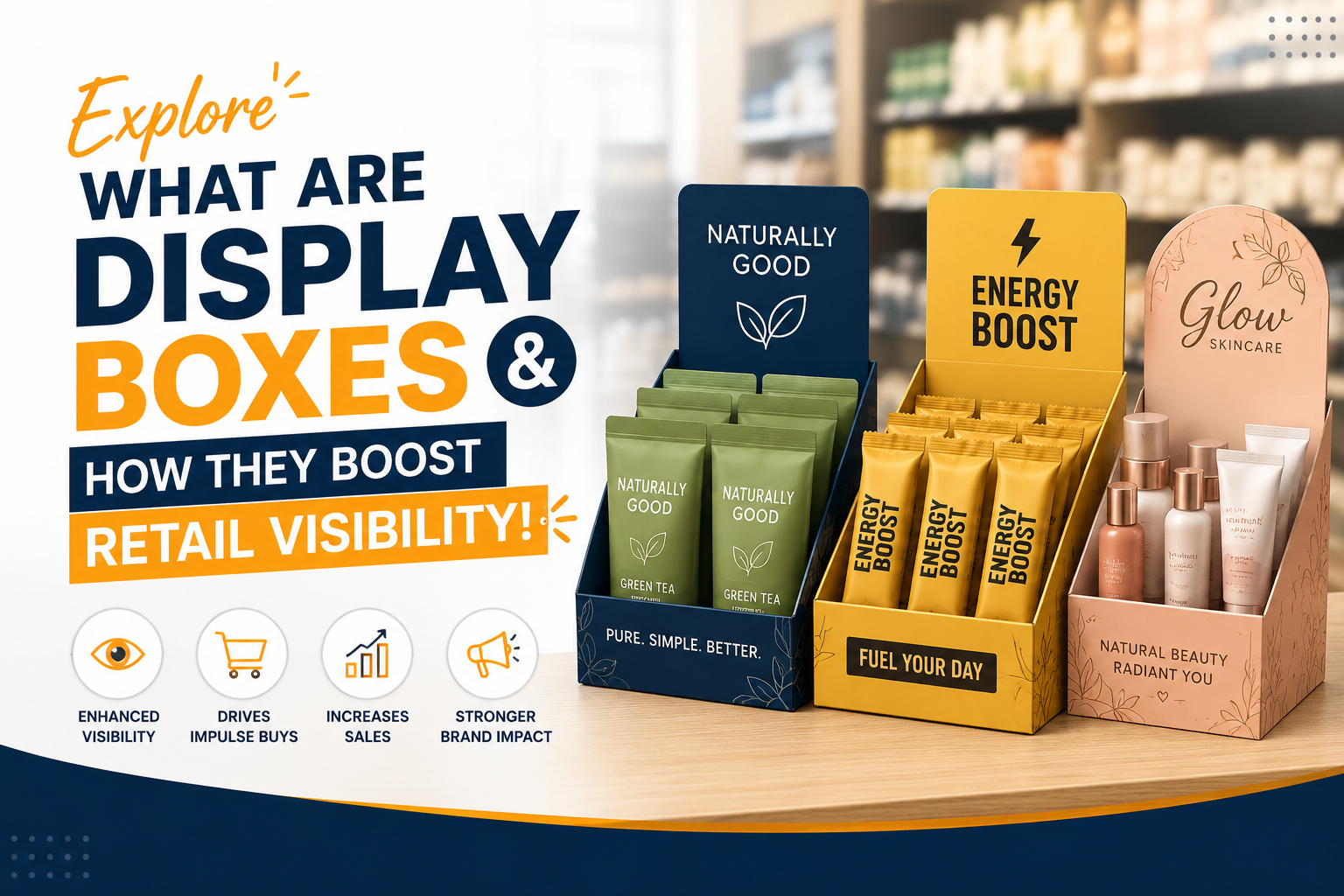
Custom Display boxes are specially designed packaging or presentation units used to showcase products attractively in a retail setting. Unlike standard shipping or storage packaging, display boxes are engineered with the customer’s eye in mind — their primary goal is to attract attention, communicate product value, and encourage purchase.
They are typically placed at point-of-sale (POS) locations, on countertops, store shelves, or as freestanding floor units in high-traffic retail areas.
How Display Boxes Differ From Regular Packaging
| Feature | Display Boxes | Regular Packaging |
| Primary Purpose | Attract & sell | Protect & transport |
| Design Focus | Visual appeal, branding | Functional, minimal |
| Placement | Retail floor, counters, shelves | Storage, shipping |
| Customer Interaction | Browsing, impulse buying | Post-purchase |
| Customization | Extensive | Limited |
In short, regular packaging gets a product from Point A to Point B. Display boxes get a product from the shelf into the customer’s hands.
Types of Display Boxes
Not all display boxes are created equal. Depending on your product, retail environment, and marketing goals, there are several types to choose from.
1. Countertop Display Boxes
These are compact, lightweight units placed directly on retail counters or checkout desks. They are ideal for small products such as lip balms, gum, batteries, or accessories. Their strategic placement near the cash register makes them perfect for impulse purchases — capturing the attention of customers while they wait.
Best for: Cosmetics, confectionery, phone accessories, gift items.
2. Floor Display Boxes (PDQ Displays)
Also known as PDQ (Pretty Darn Quick) displays, floor display boxes are freestanding units positioned in store aisles or entryways. They are larger, sturdier, and designed to hold significant product quantities. Their towering presence commands attention and is ideal for new product launches or promotional campaigns.
Best for: Beverages, snacks, toys, electronics, seasonal products.
3. Hanging Display Boxes
These are hook-mounted display boxes designed to hang on pegboards or wall-mounted retail displays. They maximize vertical space in stores, making them a smart solution for space-limited retail environments.
Best for: Small packaged goods, hardware items, personal care products.
4. Window Display Boxes
Window display boxes feature a transparent panel — usually made from PVC or acetate — that lets consumers see the product without opening the box. This style builds trust and reduces purchase hesitation, especially for products where appearance matters.
Best for: Perfumes, jewelry, cupcakes, electronics, toys.
5. Shipper Display Boxes
Shipper displays serve a dual purpose: they protect the product during shipping and transform into a display unit on the retail floor. They’re cost-effective for large-scale product distribution and eliminate the need for extra assembly at the store level.
Best for: FMCG products, beverages, food items, books.
6. Custom-Shaped Display Boxes
For brands looking to make a bold statement, custom-shaped display boxes break away from the rectangular norm. Unique die-cut structures and unconventional shapes create a memorable unboxing and browsing experience that reinforces brand identity.
Best for: Luxury goods, limited-edition products, experiential retail.
Materials Used in Display Boxes
The material you choose impacts durability, aesthetics, sustainability, and cost. Here’s a breakdown of the most commonly used materials:
Corrugated Cardboard
The most widely used material in retail display packaging. It offers excellent strength-to-weight ratio, is easy to print on, and is highly recyclable. Corrugated display boxes are budget-friendly and suitable for both short-term promotions and long-term shelf displays.
Rigid Paperboard
Known for its premium feel, rigid paperboard is used when brands want to convey luxury and quality. It holds its shape well, offers excellent print clarity, and is often used for high-end cosmetics, confectionery, and electronics.
Kraft Paper
A natural, unbleached option that appeals to eco-conscious consumers. Kraft paper display boxes project an organic, sustainable brand identity and are growing in popularity across health, food, and beauty categories.
Eco-Friendly & Recyclable Materials
With sustainability becoming a purchasing factor for modern consumers, many brands are now opting for FSC-certified, biodegradable, or recycled-content display boxes. This not only reduces environmental impact but also strengthens brand reputation.
How Display Boxes Boost Retail Visibility
This is the heart of the matter. Here’s exactly how display boxes make your product impossible to ignore:
1. Strategic Placement Drives Impulse Purchases
Research shows that over 60% of purchasing decisions are made in-store, often impulsively. Display boxes placed at eye level or near checkout counters tap directly into this behavior. A well-positioned display box puts your product in the consumer’s direct line of sight, triggering unplanned purchases.
2. Visual Branding Creates Instant Recognition
A display box is a three-dimensional billboard for your brand. Every surface — front, sides, and top — is an opportunity to showcase your logo, color palette, tagline, and brand personality. Consistent visual branding across your display packaging builds brand recall, meaning customers remember you the next time they shop.
3. Product Organization Improves Shopping Experience
Cluttered shelves confuse shoppers. Display boxes bring order and structure to product presentation, making it easy for customers to browse, compare, and select items. An organized display signals professionalism and quality — factors that subconsciously influence trust and purchase decisions.
4. They Tell Your Product’s Story at a Glance
Modern consumers don’t just buy products — they buy stories, values, and experiences. Display boxes can communicate key product benefits, certifications, ingredients, or USPs through smart design, iconography, and copy placement. A single well-designed display box can replace the need for in-store sales staff.
5. They Create a Competitive Shelf Advantage
In a retail environment where dozens of competing products fight for attention on the same shelf, display boxes give your product a visual edge. A bold, well-designed display box with dynamic graphics will always outperform a plain product sitting flat on a shelf.
6. Seasonal and Promotional Displays Generate Urgency
Limited-edition or seasonal display packaging creates a sense of urgency and exclusivity. When customers see a holiday-themed display box or a “Limited Edition” sticker, the fear of missing out (FOMO) motivates faster purchasing decisions.
Key Benefits of Display Boxes for Retailers and Brands
Beyond visibility, display boxes deliver a wide range of business benefits:
For Brands:
- Cost-effective marketing — no additional ad spend required at point of sale
- Strengthens brand identity across all retail touchpoints
- Supports new product launches with high-impact visual presence
- Increases sell-through rates and reduces time-on-shelf
For Retailers:
- Simplifies shelf management and restocking
- Maximizes floor and counter space efficiency
- Enhances the overall aesthetic of the store environment
- Encourages upselling and cross-selling when complementary products are displayed together
How to Design an Effective Display Box
A display box is only as powerful as its design. Here’s a framework for creating one that performs:
Step 1: Know Your Target Audience
Understand who your customer is. What colors, fonts, and messaging resonate with them? A display box for a teenage skincare brand will look dramatically different from one for a premium whiskey label.
Step 2: Choose the Right Size and Structure
Your display box should complement your product’s dimensions without wasted space. Oversized packaging makes products look small; undersized packaging looks cluttered. Work with your packaging supplier to get the structural design right.
Step 3: Apply Visual Hierarchy
Every effective display box has a clear visual flow:
- Headline — Your brand name or product name, large and legible
- Hero Visual — A compelling image or product shot
- Key Benefit — One strong statement that sells the product
- Call to Action — Optional, but effective (e.g., “Try Me!”, “New Flavor!”)
Step 4: Use Premium Printing and Finishes
High-quality printing elevates perceived product value. Consider finishing options like:
- Gloss lamination — vibrant, eye-catching
- Matte lamination — premium, sophisticated
- Spot UV — highlights specific design elements
- Embossing/Debossing — adds tactile texture and luxury feel
- Foil stamping — metallic accents for a high-end look
Step 5: Stay On-Brand
Every design element — fonts, colors, imagery, tone of copy — must align with your established brand guidelines. Consistency builds trust and recognition across all retail environments.
Current Trends in Display Box Packaging (2026)
The packaging industry is always evolving. Here are the trends shaping display boxes in 2026:
1. Sustainable Packaging Dominates Eco-conscious consumers are pushing brands to adopt recyclable, biodegradable, or compostable display packaging. Brands that lead with sustainability in their packaging messaging see stronger consumer loyalty.
2. Minimalist Aesthetics Clean, uncluttered designs with white space and simple typography are outperforming loud, busy graphics. Less is more — when your design breathes, your product stands out.
3. Interactive & Smart Packaging QR codes printed on display boxes link customers to product videos, tutorials, reviews, or loyalty programs, creating a phygital (physical + digital) brand experience.
4. Personalization and Limited Editions Brands are leveraging digital printing to produce short-run, personalized, or regionally targeted display packaging — creating collectible appeal and driving repeat purchase.
5. Bold Typography as Design Large-scale typographic displays are becoming a trend where the words themselves become the visual — a fresh approach that works particularly well in wellness, food, and lifestyle brands.
Display Boxes vs. Traditional Packaging: Which Should You Choose?
The answer depends on your goals:
- If your product is already established and customers know to look for it, traditional packaging may suffice.
- If you’re launching a new product, entering a competitive market, or running a promotion, display boxes are a critical investment.
- If you’re selling through physical retail (supermarkets, pharmacies, department stores), display boxes are nearly non-negotiable for achieving visibility.
In most cases, the ROI on well-designed display packaging far outweighs the additional production cost.
Conclusion: Display Boxes Are a Retail Growth Strategy
Display boxes are far more than a packaging choice — they are a retail growth strategy. In a marketplace saturated with options, the brands that invest in smart, beautiful, and strategically placed display packaging consistently outperform those that don’t.
From driving impulse purchases to building long-term brand recognition, display boxes work 24/7 as silent salespeople on your behalf. Whether you’re a startup breaking into retail or an established brand refreshing your shelf presence, the right display box can be the single most impactful change you make to your retail strategy.