



Playing Card Dimensions: The Complete Size Guide for Custom Decks


If you’ve ever held two decks of cards side by side and noticed one felt slightly wider or a touch shorter than the other, you’ve already run into the central question of this guide: what size should a playing card actually be? The honest answer is that it depends on what the cards are for. A poker night, a tarot reading, a trading card game, and a wedding favor deck all call for different dimensions, different stock thickness, and sometimes a different finish altogether. This guide walks through every common size, explains why each one exists, and gives you the exact numbers you need whether you’re ordering a custom deck for the first time or double-checking a print file before it goes to press.
The Standard Playing Card Size
When people say “standard playing card size” without any other context, they almost always mean poker size. A poker-size card measures 2.5 x 3.5 inches, which converts to 63.5 x 88.9 millimeters or 6.35 x 8.89 centimeters. At 300 DPI, the standard print resolution for cards, that works out to 750 x 1050 pixels. This is the size used in casinos, in most home card games, and in the majority of commercial decks you’d find on a store shelf.
The reason this particular size stuck as the industry default comes down to ergonomics more than tradition. A card that measures 2.5 inches across sits comfortably in an adult hand, and 3.5 inches of height leaves enough room to print a rank, a suit symbol, and any illustration without the card feeling cramped. Go much smaller and text becomes hard to read at a glance; go much larger and fanning out a hand of cards gets awkward fast.
A Quick-Reference Chart for Every Common Size
Because so many people land on this page looking for a single number, here’s a chart covering the sizes you’re most likely to need, in every unit a printer or designer might ask for.
| Card Type | Inches | Millimeters | Centimeters | Pixels (300 DPI) |
|---|---|---|---|---|
| Poker (Standard) | 2.5 x 3.5 | 63.5 x 88.9 | 6.35 x 8.89 | 750 x 1050 |
| Bridge | 2.25 x 3.5 | 57.2 x 88.9 | 5.72 x 8.89 | 675 x 1050 |
| Mini / Miniature | 1.75 x 2.5 | 44.5 x 63.5 | 4.45 x 6.35 | 525 x 750 |
| Tarot | 2.75 x 4.75 | 70 x 120 | 7 x 12 | 825 x 1425 |
| Jumbo | 3.5 x 5.0 | 88.9 x 127 | 8.89 x 12.7 | 1050 x 1500 |
| Square Novelty | 3 x 3 | 76.2 x 76.2 | 7.62 x 7.62 | 900 x 900 |
Poker Cards vs. Bridge Cards: What’s Actually Different
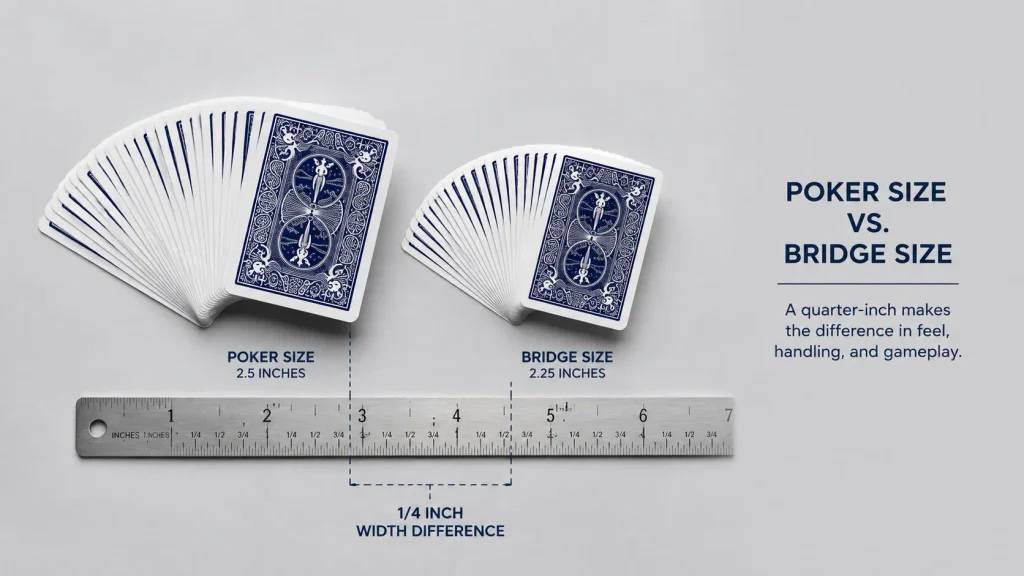
Poker and bridge cards share the same 3.5-inch height, so the difference comes down entirely to width. Poker cards are 2.5 inches wide; bridge cards are 2.25 inches wide, a quarter-inch narrower. That quarter inch doesn’t sound like much until you’re holding thirteen cards fanned out in one hand, which is exactly what happens in games like Bridge, Rummy, and Canasta. The narrower card lets players fan and rearrange larger hands without their hand cramping or the deck sprawling out too wide to manage.
Bridge-size decks are more common in Europe than in North America, where poker size dominates. If you’re designing a custom deck aimed at a European market, or building anything specifically for trick-taking card games, bridge width is worth considering over the default poker size.
Tarot Cards: Built for Artwork, Not Just Gameplay
Tarot cards break from the poker/bridge mold because their entire purpose is different. A tarot deck measures 2.75 x 4.75 inches, noticeably taller and wider than a standard playing card. That extra real estate exists because tarot cards are meant to carry detailed illustration and symbolism, from the Major Arcana’s full-scene artwork to the smaller iconographic details in the Minor Arcana suits.
Some publishers push tarot decks even larger, up to roughly 3.5 x 6 inches for oversized “gallery” editions, while pocket-friendly mini tarot decks can shrink down to around 1.75 x 3 inches. If you’re printing a custom tarot deck, decide early whether the priority is readability of fine detail (favoring the larger format) or portability (favoring mini).
Mini and Jumbo Cards: Opposite Ends of the Spectrum
Mini Playing Cards
Mini cards measure roughly 1.75 x 2.5 inches, keeping the same proportions as a standard deck but shrinking everything down. They show up most often in travel-sized games, promotional giveaways, and children’s card games where smaller hands need a smaller card to grip comfortably. Because they use the same 5:7-ish aspect ratio as poker cards, the artwork usually just scales down cleanly rather than needing to be redesigned.
Jumbo Playing Cards
Jumbo cards go the other direction, typically landing around 3.5 x 5 inches. They’re built for visibility rather than portability: card magicians use them so a whole room can follow a trick, teachers use them in classroom games so every student can read the card from their seat, and they’re popular in games designed for players with low vision. If your custom deck is meant to be seen from a distance rather than held in a hand of five or six, jumbo is the size to reach for.
Bicycle Playing Cards: The Industry Benchmark

Bicycle, manufactured by the United States Playing Card Company, is probably the most recognized playing card brand in the world, and its dimensions have effectively become an unofficial benchmark for the rest of the industry. A standard Bicycle deck follows poker size at 2.5 x 3.5 inches, with a bridge-size option also available at 2.25 x 3.5 inches. Individual cards run about 0.28 mm thick, finished with Bicycle’s signature air-cushion coating, which is what gives the deck that smooth, slightly textured shuffle feel players associate with the brand.
Because Bicycle decks are so widely used as a reference point, matching their dimensions is a safe move if you want your custom deck to feel familiar in players’ hands and to fit inside standard card sleeves, deck boxes, and storage cases without any surprises.
How Thick Should a Playing Card Be?
Thickness matters just as much as length and width, even though it gets less attention. Standard playing card stock runs between 0.2 mm and 0.3 mm, which usually corresponds to paper in the 270–300 GSM range. Premium and casino-grade stock pushes up to 0.30–0.35 mm, often with a plastic coating or a full plastic core, which adds durability and a distinct snap to the shuffle.
Thickness affects more than just how sturdy a card feels. It changes how easily a deck shuffles, how the cards fan out, and how long the deck lasts under regular use. A deck that’s too thin will feel flimsy and wear out quickly at the corners; one that’s too thick can be awkward to riffle-shuffle and may not fit standard sleeves or tuck boxes.
Deck of Cards Box Dimensions
The tuck box that holds a standard 52-card deck (plus jokers) is typically sized just a little larger than the cards themselves to prevent shifting during shipping and storage. A common tuck box measures around 2.5–2.75 inches wide by 3.5–3.75 inches tall by 0.75–1 inch deep, just enough room for the full deck to sit snugly without excess empty space inside the box. If you’re designing custom packaging for a deck, err on the tighter side of that range: a loose-fitting box lets cards rattle around and wears down corners faster than a snug one.
Card Design Specs You’ll Need Before You Print
If you’re preparing artwork for a custom deck, keep these production numbers in mind so your files come back looking the way you designed them:
- Print resolution: 300 DPI minimum for crisp text and clean edges.
- Bleed: extend your background art 0.125 inches past the trim line on every side.
- Safe area: keep any text or important graphics at least 0.125 inches inside the trim line.
- Corner radius: most decks use a 3.5–6 mm rounded corner, which needs to be accounted for separately from the bleed and safe zones.
- Aspect ratio: standard playing cards follow roughly a 5:7 width-to-height ratio, which is worth keeping in mind if you’re adapting artwork from a different card format.
Skipping the bleed allowance is the single most common mistake in first-time card designs. Without it, any slight shift during cutting leaves a thin white sliver along one edge of the card, which is easy to avoid by simply extending your artwork past the trim line from the start.
Choosing the Right Dimensions for Your Project
With so many size options on the table, it helps to work backward from what the deck is actually for rather than defaulting to “standard” out of habit:
- Classic card games (poker, blackjack, most home games): poker size, 2.5 x 3.5 inches.
- Games where players hold large hands (bridge, rummy, canasta): bridge size, 2.25 x 3.5 inches.
- Tarot readings or art decks: 2.75 x 4.75 inches, or larger for gallery-style editions.
- Travel games, favors, or kids’ games: mini, around 1.75 x 2.5 inches.
- Magic tricks, classroom use, or accessibility-focused games: jumbo, around 3.5 x 5 inches.
- Trading card games or anything meant to fit standard sleeves: poker size, to stay compatible with off-the-shelf sleeves and storage boxes.
Whatever size you land on, the goal is the same: the dimensions should serve how the cards will actually be used, not just match whatever the last deck you saw happened to be.
Custom Playing Card Printing at ZK Print Solutions
At ZK Print Solutions, we print custom playing cards across every size covered in this guide, from pocket-friendly minis to oversized jumbo decks, in the stock thickness and finish your project calls for. Whether you’re producing a branded deck for a promotional campaign, a full tarot set with intricate cover-to-cover artwork, or a custom game with its own unique card size, our team can help you land on the right dimensions before your files ever go to print, and make sure the final product feels as good in the hand as it looks on screen.
If you’re ready to start a custom deck or just want a second opinion on your print-ready files, get in touch with our packaging specialists at ZK Print Solutions.