



What are foldable rigid boxes?

In the world of packaging, businesses have long faced a familiar dilemma: choose packaging that looks luxurious, or choose packaging that’s practical and cost-efficient. For years, that felt like a trade-off with no perfect solution. Traditional rigid boxes deliver a premium unboxing experience but are bulky, expensive to ship, and difficult to store in large quantities. Standard folding cartons solve the space problem but often lack the high-end feel that luxury brands demand.
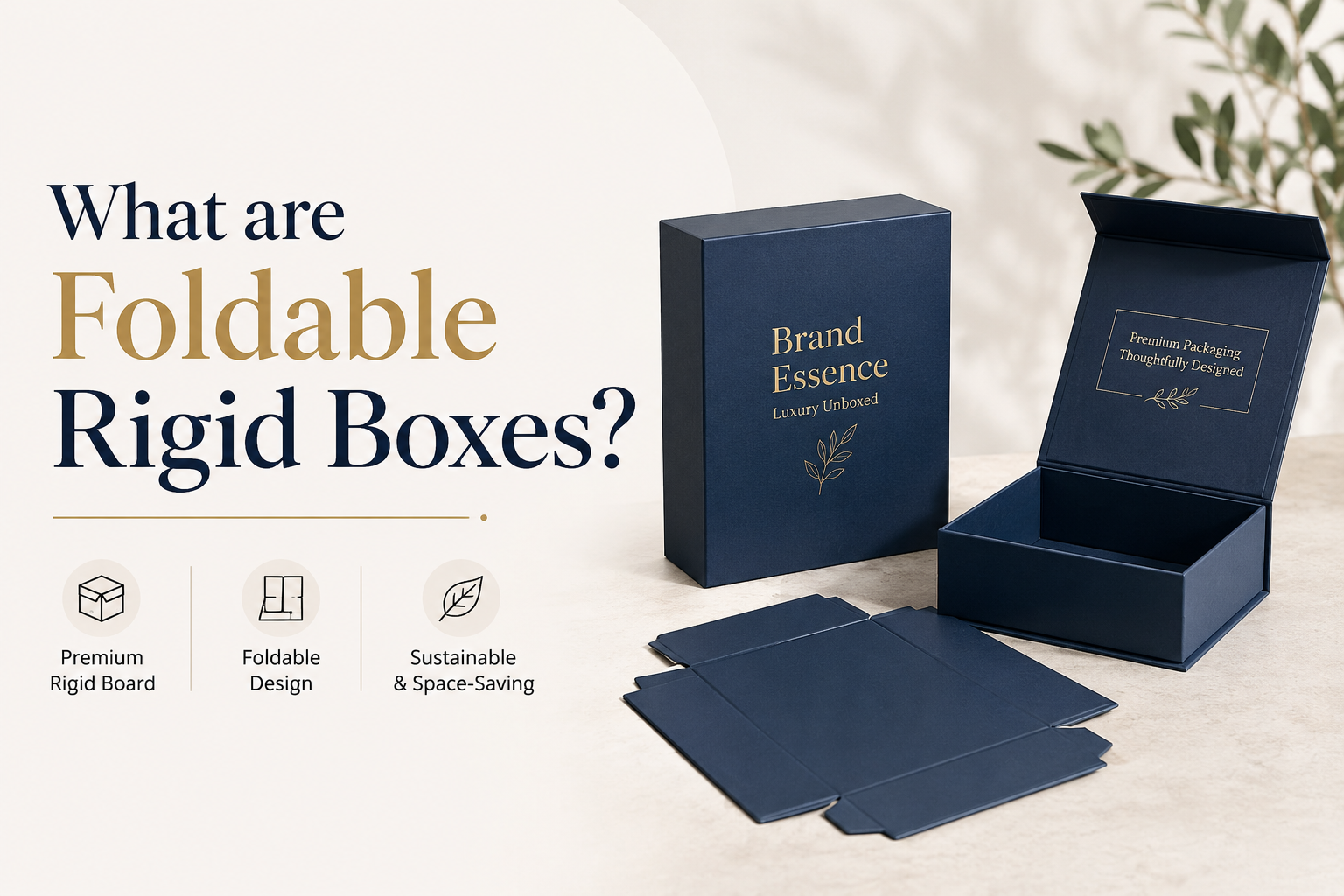
Enter the foldable rigid box — a packaging innovation that bridges the gap between elegance and efficiency. Combining the structural strength and visual appeal of a rigid box with the flat-pack convenience of a folding carton, foldable rigid boxes are rapidly becoming the go-to choice for brands that refuse to compromise on either quality or practicality.
Whether you’re a luxury retailer, an e-commerce brand, or a corporate gifting specialist, understanding foldable rigid boxes — and how they relate to the broader world of custom rigid boxes — could transform the way you think about packaging.
What Are Foldable Rigid Boxes?
A foldable rigid box — also known as a collapsible rigid box — is a type of premium packaging that can be assembled into a sturdy, elegant box and then collapsed flat when not in use. Like all custom rigid boxes, they are built to precise dimensions and finished to a brand’s exact specifications. Unlike traditional rigid boxes, which are permanently glued into shape, foldable rigid boxes are engineered with scored panels and flexible joints that allow them to fold down for storage and shipping, then pop back into their full form when needed.
How They Differ from Traditional Rigid Boxes
Traditional rigid boxes are manufactured in their final shape. They’re assembled at the factory, wrapped in decorative paper, and shipped as-is — taking up significant space at every step of the supply chain. While they look and feel premium, they are essentially impossible to flatten without destroying the box.
Foldable rigid boxes maintain the same high-end appearance and structural integrity but are built with a collapsing mechanism. When folded flat, they can reduce their volume by up to 80%, making them far more practical for brands managing large inventories or shipping boxes internationally.
How They Differ from Standard Folding Cartons
Standard folding cartons — the kind you might see housing cereal or toothpaste — are made from thin paperboard and are lightweight by design. They fold flat for transport but don’t offer the rigidity, weight-bearing capacity, or premium aesthetic of a rigid box.
Foldable rigid boxes sit in a category of their own. They’re constructed from thick greyboard or chipboard (typically 1.5mm to 3mm thick), covered in specialty decorative paper or fabric, and often feature magnetic closures or ribbon pulls. The result is a box that feels substantial and luxurious in the hands of a consumer — not flimsy or disposable.
Key Structural Components
- Greyboard or chipboard panels — the rigid base material that gives the box its strength
- Scored fold lines — precision cuts that allow the panels to collapse without cracking
- Decorative outer wrap — printed paper, fabric, or specialty material laminated to the board
- Magnetic closures — embedded magnets in the lid and base for a satisfying, secure close
- Internal hinges or corner joints — flexible connectors that hold panels together while allowing movement
- Interior liners or inserts — foam, fabric, or cardboard elements that hold the product securely
How Foldable Rigid Boxes Work
The magic of a foldable rigid box lies in its engineering. The four side panels of the box are connected to one another and to the base through flexible joints — typically made from a combination of scored greyboard and a flexible paper hinge. These joints allow the panels to rotate inward when pressure is applied, collapsing the box into a flat configuration.
The Folding Mechanism Explained
When collapsed, the four side panels fold flat against the base panel, reducing the box to a thickness of just a few millimeters. The lid, which is often attached via a magnetic flap or separate panel, folds flat separately. The result is a neat, flat package roughly the size and thickness of a large hardcover book.
When it’s time to use the box, the panels are simply pushed outward and lock into place — either through the tension of the material itself or via small corner locks built into the design. Magnetic closures then draw the lid into alignment, creating a crisp, professional finish.
Assembly and Disassembly
One of the key advantages of foldable rigid boxes is how easy they are to assemble. Unlike some flat-pack furniture or complex packaging designs, a foldable rigid box can typically be assembled in seconds — no tools, no adhesives, no instructions needed. The same is true for collapsing; a few inward presses and the box is flat again.
This makes them ideal for retail environments where staff need to assemble packaging quickly, as well as for consumers who may want to reuse the box for storage or gifting.
Materials Commonly Used
- Greyboard (chipboard): The standard base material, available in varying thicknesses. Heavier boards produce stiffer, more premium-feeling boxes.
- Specialty outer papers: Textured papers, kraft papers, coated art papers, or even fabric wraps are laminated to the exterior for a decorative finish.
- Flexible inner liners: Thin kraft or art paper is used to line the interior and reinforce the fold lines.
- Magnets: Small, powerful neodymium magnets are embedded in the lid and base panels to create a satisfying magnetic closure.
Common Uses & Applications
The versatility of foldable rigid boxes makes them suitable for a wide range of industries and product categories. Here’s a look at where they’re most commonly used:
Luxury Retail
Jewelry brands, cosmetics companies, and high-fashion labels were among the first to adopt foldable rigid boxes. These industries rely on packaging to communicate brand value, and the premium feel of a rigid box is essential. The foldable format allows luxury brands to ship packaging flat — reducing freight costs significantly — without sacrificing the unboxing experience.
Electronics and Tech Accessories
Headphones, smartwatches, charging accessories, and other tech products are increasingly being packaged in foldable rigid boxes. The sturdy construction protects delicate electronics during shipping, while the premium finish helps justify premium price points.
Food and Confectionery
Chocolate brands, premium tea companies, and artisan food producers use foldable rigid boxes for gift sets and seasonal collections. The rigid structure keeps delicate products safe, and the flat-pack format makes seasonal storage — think holiday packaging — far more manageable.
Corporate Gifting and Promotional Packaging
Businesses sending branded gift sets to clients or employees need packaging that makes an impression. Foldable rigid boxes function as fully custom printed boxes — logo printing, brand colors, bespoke inserts, and premium finishes can all be specified — while being easy to store in bulk until they’re needed.
Subscription Boxes and E-Commerce
As the subscription box market has grown, so has demand for packaging that ships efficiently and arrives intact. Foldable rigid boxes reduce shipping costs because they can be sent flat and assembled at fulfillment centers or by the end customer. Many premium subscription brands use them to elevate the perceived value of their boxes.
Perks & Advantages
The growing popularity of foldable rigid boxes is no accident. They offer a compelling combination of benefits that address real pain points for modern brands.
Space Efficiency
The most immediate and measurable advantage is space saving. A traditional rigid box occupies the same volume whether it’s filled with product or sitting empty in a warehouse. A foldable rigid box, when collapsed, takes up roughly 20% of that space. For a brand storing thousands of boxes, this translates to dramatically reduced warehouse costs and far simpler inventory management.
The same logic applies to shipping. Sending flat-pack boxes to fulfillment centers or retail partners costs a fraction of shipping pre-assembled rigid boxes. This is especially impactful for international supply chains, where freight costs are calculated by volume.
Cost Savings on Logistics
Beyond warehousing, the flat-pack format reduces freight costs at every stage — from the manufacturer to the distribution center, from the warehouse to the retail store. Over time, these savings can be substantial, often offsetting the slightly higher unit cost of foldable rigid boxes compared to standard cartons.
Premium Look and Feel Retained
Perhaps the most impressive aspect of foldable rigid boxes is what they don’t sacrifice. Despite their collapsible design, they look and feel every bit as luxurious as a traditional rigid box. The thick board, decorative wrap, and magnetic closure all contribute to a premium tactile experience that standard folding cartons simply cannot replicate.
Eco-Friendly Potential
Foldable rigid boxes have a lower carbon footprint than traditional rigid boxes when you factor in transportation. Fewer truck loads, fewer flights, and less packaging material used in transit all add up. Many are also made from recyclable materials and can be designed for reuse — a growing priority for environmentally conscious consumers.
Customization Options
Foldable rigid boxes offer extensive design flexibility. Brands can choose from a wide range of exterior finishes, printing techniques, closure styles, and interior configurations. Whether you want a matte black box with gold foil stamping or a soft-touch pastel design with a ribbon pull, the options are virtually limitless.
Enhanced Unboxing Experience
The ritual of opening a beautifully designed box has become a marketing moment in itself — driven in part by unboxing culture on social media. Foldable rigid boxes deliver that moment consistently: the satisfying click of a magnetic closure, the reveal of a lined interior, the weight and solidity of the box in the hands. These details drive repeat purchases, social sharing, and brand loyalty.
Potential Drawbacks to Consider
No packaging solution is perfect for every situation, and foldable rigid boxes are no exception.
Higher Upfront Manufacturing Cost
Compared to standard folding cartons, foldable rigid boxes have a higher per-unit cost due to the complexity of their construction. For brands operating on tight margins or working with very high volumes of lower-priced products, this can be a limiting factor.
Weight and Material Limitations
While foldable rigid boxes are sturdy, they have practical weight limits. Very heavy products may require additional structural reinforcement, and the folding mechanism means they are not suitable for products that exert significant outward pressure on the box walls.
Not Ideal for All Product Types
Foldable rigid boxes work best for products that fit neatly within their dimensions and don’t require airtight or moisture-resistant packaging. Food products with strict barrier requirements, for example, are generally better served by specialist food-grade packaging.
Foldable vs. Traditional Rigid Boxes: A Quick Comparison
| Feature | Foldable Rigid Box | Traditional Rigid Box |
| Storage | Flat-pack, 80% space saving | Bulky, fixed shape |
| Shipping Cost | Low (ships flat) | High (ships assembled) |
| Assembly | Required (seconds) | Ready to use |
| Premium Feel | High | High |
| Customization | Extensive | Extensive |
| Reusability | High | Moderate |
| Unit Cost | Moderate–High | Moderate–High |
| Eco Impact | Lower (less freight) | Higher (more freight) |
| Best For | High-volume, premium brands | Lower-volume, retail display |
Customization & Design Options
One of the strongest selling points of foldable rigid boxes is how extensively they can be tailored to a brand’s identity. In effect, they are among the most versatile custom printed boxes on the market — every surface, finish, closure, and interior can be specified to match a brand’s exact vision. Here’s an overview of the main customization dimensions:
Printing Techniques
- Foil stamping: Metallic or holographic foil applied to the surface for a high-end, eye-catching finish
- Embossing and debossing: Raised or recessed patterns pressed into the board to add texture and dimension
- UV spot coating: A glossy varnish applied to specific areas to create contrast with a matte background
- Full-color offset printing: High-resolution imagery and color printing directly on the outer wrap
Closure Types
- Magnetic closure: The most popular choice for luxury packaging — discreet magnets in the lid and base create a satisfying snap
- Ribbon pull: A fabric ribbon attached to the base makes opening effortless and adds a gift-like feel
- Tuck flap: A simpler, more economical closure suitable for lighter-duty applications
- Velcro or press stud: Less common but useful for boxes that will be opened and closed frequently
Interior Options
- Foam inserts: Custom-cut foam that cradles the product securely — ideal for electronics, jewelry, and fragile items
- Fabric lining: Silk, velvet, or satin fabric glued to the interior walls for an ultra-premium feel
- Cardboard dividers: Corrugated or solid board dividers for multi-product gift sets
- Vacuum-formed trays: Plastic trays molded to the exact shape of the product
Sustainability Angle
As consumer awareness of environmental issues grows, packaging sustainability has moved from a nice-to-have to a business necessity. Foldable rigid boxes have a number of sustainability credentials worth highlighting.
Reusability Factor
Unlike disposable packaging, a well-made foldable rigid box is built to last. Consumers frequently repurpose them for storage — keeping jewelry, keepsakes, or stationery in the box long after the original product has been used. This extended lifecycle reduces the effective environmental impact of the packaging per use.
Material Sourcing Considerations
Many foldable rigid boxes are made from recycled or FSC-certified greyboard, which uses responsibly sourced wood fiber. Brands can also specify water-based adhesives, soy-based inks, and recyclable outer papers to further reduce their environmental footprint.
Reduced Transportation Emissions
Because foldable rigid boxes ship flat, they require significantly fewer truck loads and air freight shipments than pre-assembled rigid boxes. This reduction in transportation volume directly translates to lower carbon emissions — a measurable and increasingly important metric for brands with sustainability commitments.
Consumer Perception
Research consistently shows that consumers associate premium, reusable packaging with environmental responsibility — especially when brands communicate the story behind it. A foldable rigid box that ships flat, reduces waste, and doubles as a storage box is a compelling sustainability story that resonates with modern shoppers.
Conclusion
Foldable rigid boxes represent one of the most significant innovations in premium packaging of the past decade. As a category of custom rigid boxes, they’ve solved the long-standing tension between luxury presentation and logistical practicality, opening up new possibilities for brands across industries — from fine jewelry and cosmetics to tech accessories and corporate gifting.
The core advantages are clear: dramatic space savings in storage and shipping, a retained premium look and feel, extensive customization options, and growing sustainability credentials. For brands shipping significant volumes of premium-packaged products, the logistics savings alone can more than justify the investment.