



Length, Width, and Height of a Box: How to Measure Packaging Dimensions Correctly

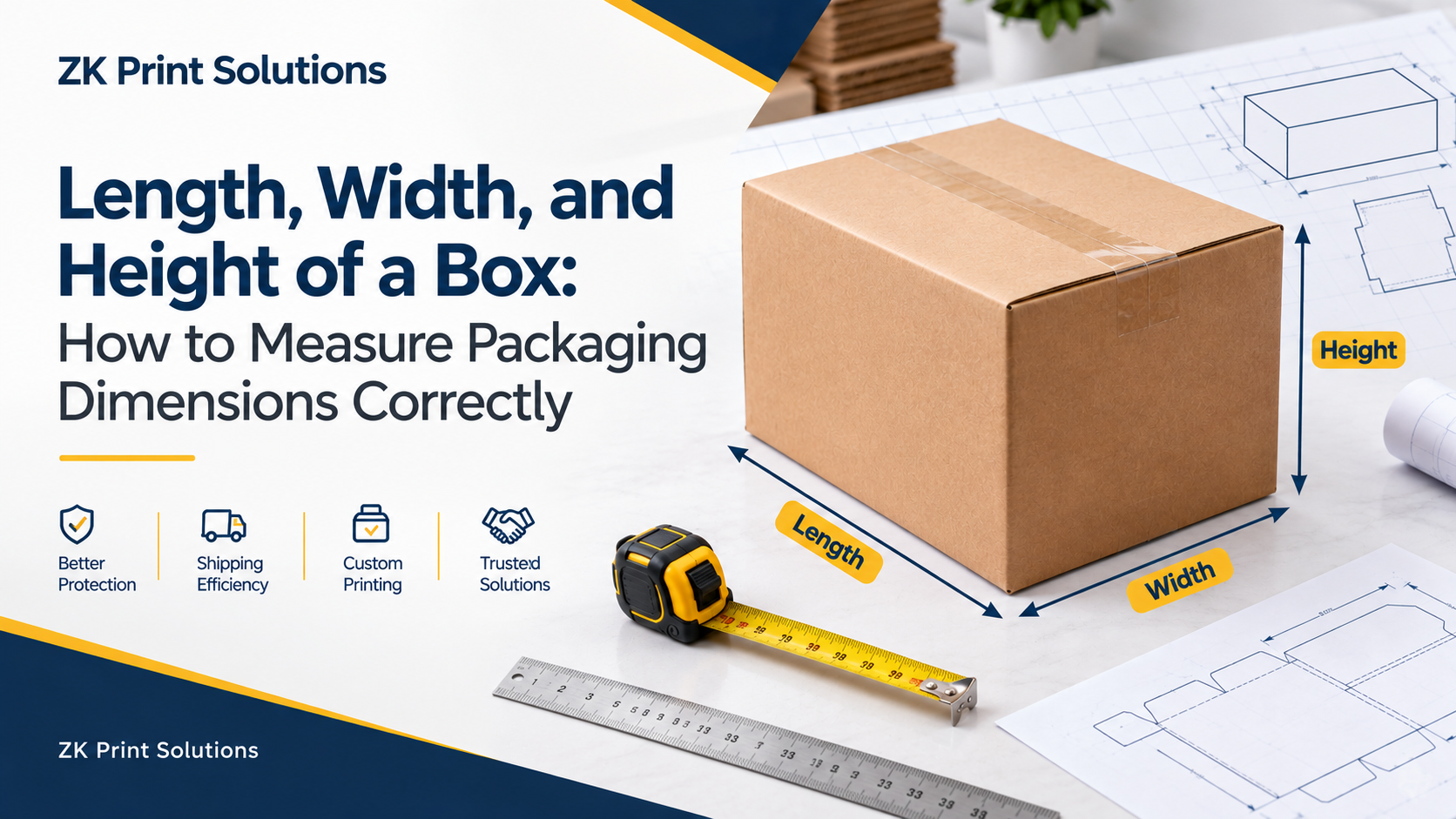
When a box is too small, the product may not fit or may be damaged during packing. When it is too large, the product can move inside the carton, require more void fill, occupy more warehouse space, and potentially cost more to ship. Understanding length, width, and height helps you choose packaging that protects the product and represents your brand professionally.
The standard way to write rectangular box dimensions is:
Length × Width × Height (L × W × H)
For example, a box measuring 16 × 12 × 8 inches is 16 inches long, 12 inches wide, and 8 inches high. The order is important when communicating with a packaging supplier, even though multiplying the same three numbers produces the same physical volume.
What do length, width, and height mean on a box?
For a conventional carton, use the following definitions:
| Dimension | How to identify it | Why it matters |
| Length | Usually the longest side of the box opening or base. On many cartons, it is the longer flap-bearing side. | Determines the primary orientation of the product and contributes to shipping size and volume. |
| Width | The shorter side of the opening or base, perpendicular to length. | Determines the available side-to-side space. |
| Height | The standing distance from the bottom of the carton to the top, normally the side without the flaps. It may also be called depth. | Determines how much vertical space is available for the product, protection, and closure. |
The orientation can change how a dimension is described. A tall box may have a small length and width but a large height. A long carton may have a large length and a small width and height. For that reason, always show the physical orientation when sending dimensions to a supplier.
A useful text diagram is:
Top opening: Length × Width
Standing distance: Height or Depth
Recorded size: Length × Width × Height
Packaging suppliers often use height and depth interchangeably. Ask the supplier to confirm the convention if the box has an unusual structure, a hinged lid, a telescoping design, or a die-cut shape.
Inside dimensions versus outside dimensions
One of the most important packaging decisions is knowing whether you need the inside or outside measurements. These measurements serve different purposes.
| Purpose | Measurement to use | Reason |
| Product fit | Inside dimensions | They describe the usable space available for the product, insert, divider, and cushioning. |
| Custom box design | Usually inside dimensions first | The interior must accommodate the product; material thickness and structure are then engineered around it. |
| Warehouse planning | Outside dimensions | They describe the footprint and height of the finished carton or packed parcel. |
| Shipping label and carrier rating | Outside dimensions of the completed parcel | Carriers rate the package they receive, including the carton, closure, tape, and protrusions. |
| Reordering the same packaging | The approved specification for both inside and outside dimensions | Recording both prevents confusion between usable product space and finished shipping size. |
Corrugated board, fluting, paperboard thickness, rigid-board construction, inserts, and folds all affect the relationship between inside and outside dimensions. Do not assume that an outside measurement is the same as the usable internal space.
How to measure a box: step-by-step method
Use a ruler or measuring tape that is appropriate for the carton size. Measure an assembled box rather than relying on a flat dieline unless your packaging supplier specifically asks for flat dimensions.
1. Prepare the carton. Open or assemble it into the state in which it will be used. Remove loose packing material, but keep any permanent insert or divider that affects product fit.
2. Measure the length. Measure the longest side of the inside opening or base. If the carton has flaps, this is commonly the longer flap-bearing side.
3. Measure the width. Measure the shorter side of the opening, perpendicular to the length.
4. Measure the height. Measure from the bottom of the carton to the top of the usable interior. Do not include the flaps in the usable height.
5. Measure the product and protection. Include the product, accessories, inserts, dividers, cushioning, and any space needed to close the box without compression.
6. Record the units. Use inches or millimeters consistently. Do not combine inches and centimeters in the same calculation.
7. Record both sets of dimensions. For a shipping carton, keep the inside dimensions for fit and the outside dimensions for shipping and storage.
8. Confirm the final packed parcel. After packing and sealing, measure the completed package again and record its weight.
For repeat production, record the board or material specification, insert design, closure method, packed weight, finished outside dimensions, and approved artwork reference alongside the dimensions.
How to calculate the right box size for a product
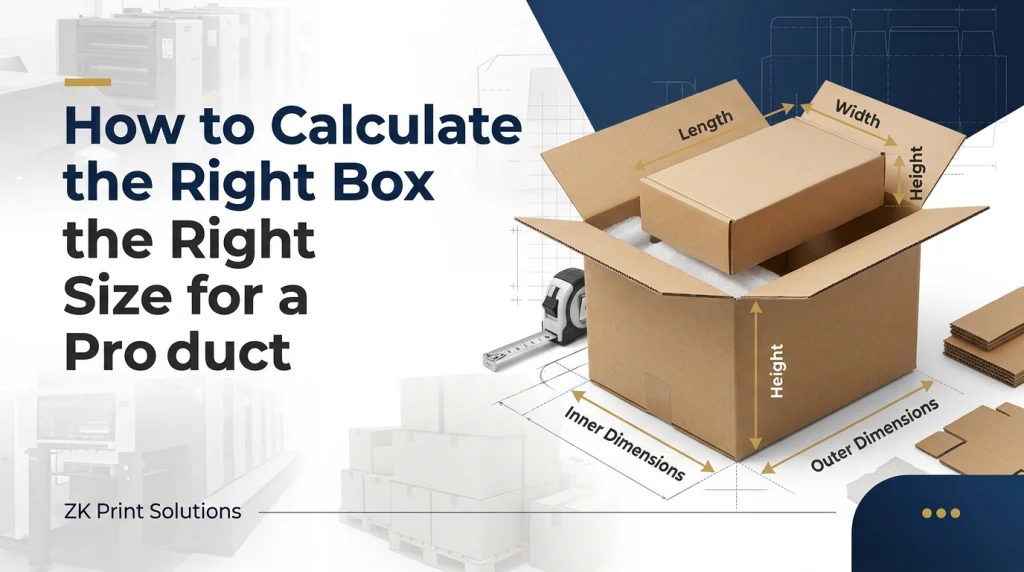
Do not choose a carton by matching its dimensions exactly to the product. The product needs room for protection, inserts, accessories, closure, and—depending on the item—a controlled amount of movement.
A practical sizing method is:
Required inside dimension = product dimension + protection on one side + protection on the opposite side + insert or clearance allowance
Example: product with cushioning
Suppose a product measures 10 × 7 × 4 inches and requires approximately 1 inch of cushioning on every side. The minimum usable interior should be approximately:
· Length: 10 + 1 + 1 = 12 inches
· Width: 7 + 1 + 1 = 9 inches
· Height: 4 + 1 + 1 = 6 inches
The starting interior specification is therefore 12 × 9 × 6 inches, subject to the cushioning material, product fragility, closure design, and packing test.
For a fragile product, do not treat this calculation as a safety certification. A packaging professional may recommend a different clearance, insert, partition, or board construction after reviewing the product and shipping conditions.
Multiple products and inserts
For a multi-item pack, calculate the layout rather than simply adding each product dimension. The correct specification depends on whether products sit side by side, end to end, in layers, or inside individual cavities. Measure the complete packed arrangement, including dividers and separators.
Box volume: the L × W × H formula
The physical volume of a rectangular carton is calculated as:
Volume = Length × Width × Height
If the dimensions are in inches, the result is in cubic inches. If the dimensions are in centimeters, the result is in cubic centimeters.
For a 16 × 12 × 8-inch box:
16 × 12 × 8 = 1,536 cubic inches
Keep the units consistent. Do not label a result as cubic centimeters when the input dimensions were measured in inches.
Physical volume helps with product-fit planning, storage, pallet layout, material planning, and shipping analysis. It is not the same thing as the price a carrier will charge.
Dimensional weight and length-plus-girth
Carriers may compare the package’s actual weight with its dimensional weight, which represents the space the package occupies. The chargeable amount can depend on the higher value and on the carrier’s current service rules.
A general dimensional-weight formula is:
Dimensional weight = Length × Width × Height ÷ carrier divisor
Carrier procedures may require each measurement to be rounded before calculation, and the divisor may vary by service or rate type. For example, UPS currently describes dimensional weight using a divisor and lists different divisor values for certain rate types on its official guidance.[4] FedEx explains that its dimensional-weight calculation uses the package’s cubic size and a divisor for applicable U.S., Puerto Rico, and international shipments.[5]
For a rectangular package, girth is commonly calculated as:
Girth = 2 × Width + 2 × Height
The combined measurement is:
Length plus girth = Length + 2 × Width + 2 × Height
UPS states that its small-package services use length plus girth as part of the size calculation and instructs shippers to measure the longest side as length.[4] Always check the current carrier page and service guide before relying on a limit, divisor, rounding rule, or billing example.
Choosing the right box type and construction
The dimensions are only one part of a safe packaging specification. The box style and material should match the product, weight, handling environment, storage conditions, and presentation requirements.
| Packaging need | Possible direction | Key decision |
| Products with similar length, width, and height | Cube or near-cube carton | Check that the product can be packed without excess void space. |
| Books, electronics, apparel, and boxed retail products | Rectangular carton | Orient the product to reduce unused volume and movement. |
| Rods, rolled materials, fixtures, and long components | Long carton or specialized structure | Confirm bending, end protection, and carrier size constraints. |
| Lightweight shipping products | Single-wall corrugated or mailer-style construction | Confirm stacking and transit requirements rather than choosing only by price. |
| Heavy, fragile, or stacked shipments | Stronger or double-wall construction, inserts, or engineered supports | Consider product weight, compression, handling, and moisture exposure. |
| Premium retail presentation | Printed folding carton, rigid box, sleeve, or coordinated insert | Balance internal fit, shelf appearance, print quality, and protection. |
Single-wall and double-wall corrugated constructions are not interchangeable. Flute profile, board grade, edge-crush performance, stacking height, moisture, and handling conditions can all affect the result. A supplier should review the complete use case before recommending a construction.
Measuring irregular products and special packaging
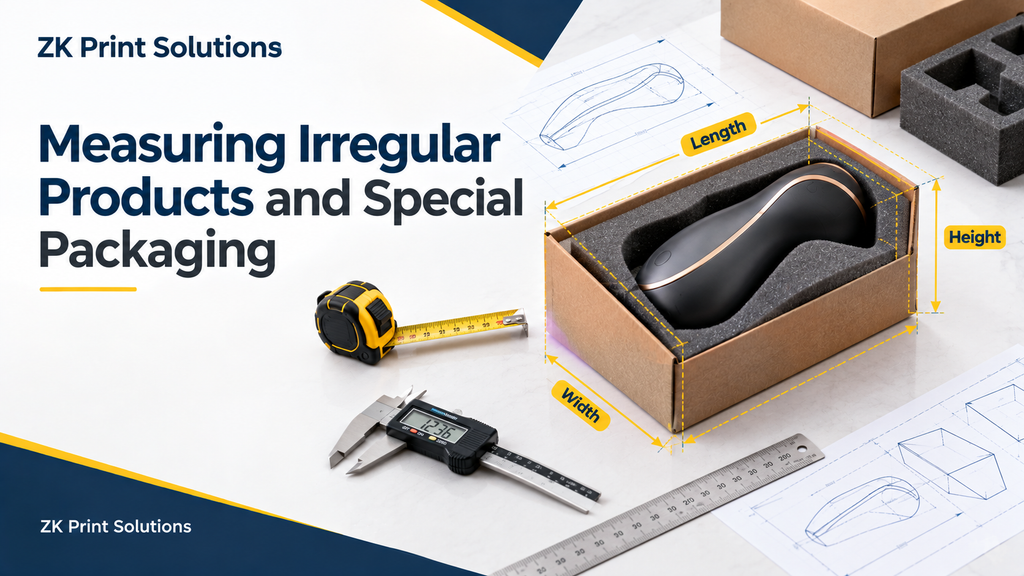
If the product or parcel is irregular, identify the extreme points and imagine the smallest rectangular envelope that contains the item. UPS describes a similar theoretical-rectangular approach for irregular packages.[4] This is a shipping measurement method, not necessarily the best custom-packaging design.
Special cases that may need separate engineering include:
· Hinged-lid and tuck-top boxes.
· Mailers with curved or flexible panels.
· Telescoping cartons with overlapping sections.
· Die-cut boxes with tabs, locks, and irregular profiles.
· Long products that require end blocks or internal supports.
· Multiple products separated by dividers.
· Retail boxes with trays, sleeves, or presentation inserts.
For these structures, send the product dimensions, product photos or sketches, packing orientation, insert requirements, and shipping conditions to the packaging supplier. For a retail-ready structure, explore ZK’s custom tuck-top boxes.
Custom printed packaging: what to send your supplier
A box-size request is most useful when it contains more than three numbers. Give the supplier a complete brief with:
· Product dimensions and weight.
· Number of products per box.
· Product orientation and packing layout.
· Cushioning, insert, divider, or accessory requirements.
· Desired inside dimensions, if already known.
· Shipping destination and likely handling conditions.
· Retail, e-commerce, food, cosmetic, industrial, or other use case.
· Preferred material or sustainability requirement.
· Printed panels, branding, finishes, and color requirements.
· Existing artwork, dieline, logo, or brand guidelines.
· Target quantity and desired delivery date.
For printed packaging, the dieline must account for folds, glue areas, bleed, safe zones, panel orientation, and the chosen material. Artwork should not be finalized until the structural design and dieline have been reviewed.
ZK Print Solutions presents custom packaging, custom printing, and custom branding as connected services. Its website also describes a process that includes artwork support, a 3D digital proof, proof approval before production, quality inspection, and tracked delivery in the United States.[6] For a project-specific recommendation, send ZK your product dimensions and request a custom box-size and print quote.
Packing-test checklist before production
Before approving a repeat production run, test the complete package rather than the empty carton.
| Check | What to record |
| Product fit | Product orientation, clearance, inserts, and movement. |
| Closure | Whether the lid or flaps close without crushing the product or stressing the board. |
| Protection | Cushioning type, quantity, and position. |
| Finished size | Outside length, width, and height after packing and sealing. |
| Weight | Actual packed weight using the final contents and materials. |
| Handling | Results of practical handling, stacking, and transit evaluation appropriate to the product. |
| Artwork | Approved proof, color reference, dieline revision, and print finish. |
| Repeatability | Final specification that can be used for the next order. |
A successful packing test should be documented. If the product shifts, the carton collapses, the closure fails, the printed panels are misaligned, or the package is larger than necessary, revise the structure before placing the full order.
Why right-sized packaging matters
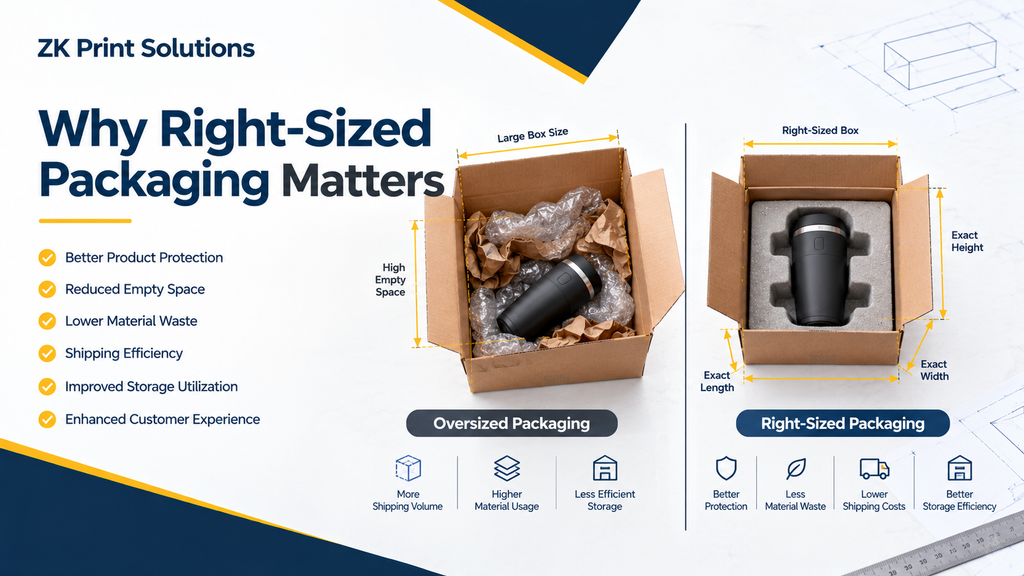
Right-sizing is not simply about using the smallest possible carton. The goal is to balance product protection, material use, void fill, shipping cost, storage, assembly time, retail appearance, and customer experience.
A carton that is too large can increase empty space, require more protective material, occupy more warehouse and vehicle volume, and increase dimensional-weight exposure. A carton that is too small can crush the product, damage the print, prevent proper closure, or increase returns. The right specification is the smallest practical package that protects the product under its expected conditions.
Frequently asked questions
Which side is length, width, and height on a box?
Length is normally the longest side of the opening or base, width is the shorter perpendicular side, and height is the standing distance from bottom to top. The standard written order is L × W × H.
Are box dimensions inside or outside dimensions?
It depends on the source. Packaging listings commonly use usable inside dimensions, while carriers need the outside dimensions of the completed parcel. Ask the supplier which convention is being used and keep both measurements for a custom packaging project.
Is depth the same as height?
Packaging companies may use depth and height interchangeably, but the meaning depends on orientation. Confirm the intended orientation before approving a dieline or quote.
How much bigger should a box be than the product?
Add the product’s protection, insert, divider, accessory, closure, and clearance requirements to each relevant dimension. There is no universal allowance for every product. Fragility, cushioning type, packing method, and shipping conditions determine the final specification.
How do I calculate the cubic size of a box?
Multiply length by width by height. A 16 × 12 × 8-inch carton has a physical volume of 1,536 cubic inches.
Does a larger box always cost more to ship?
Not always, but a larger package can increase dimensional weight and carrier-rated volume. Carriers may compare actual and dimensional weight, so use the current rules for the service you plan to use.
Can I use a large box for a heavy product?
A large box is not automatically suitable for a heavy product. Check the board construction, compression strength, closure, internal supports, and expected handling conditions. A smaller, properly engineered carton may provide better protection.
What should I send ZK Print Solutions for a custom quote?
Send the product’s length, width, height, weight, packing orientation, protection requirements, quantity, artwork or logo, preferred material, delivery location, and target date. If the product is irregular, include photographs or a sketch. ZK can then advise on the structure, printed design, and next steps for proofing.
Conclusion
The correct order for most rectangular packaging is Length × Width × Height. Measure the product and the finished carton carefully, distinguish inside dimensions from outside dimensions, calculate volume with consistent units, and account for cushioning, inserts, closure, material thickness, and carrier rules.
For custom printed packaging, the best result comes from treating dimensions as part of a complete packaging brief rather than as three isolated numbers. Share your product details with ZK Print Solutions to discuss a box structure, printed design, proof, and production path suited to your product and brand, or contact the ZK team with your requirements.