

Standard Envelope Dimensions: A Practical Size Guide for Business Mail, Invitations, and Custom Printing


The correct envelope size protects the contents, supports a professional presentation, and helps prevent avoidable mailing problems. For most U.S. business correspondence, a #10 envelope measuring 4 1/8 × 9 1/2 inches is the practical starting point. Cards and invitations usually need a different format, while brochures, catalogs, and unfolded documents often require a larger envelope or mailer.
This guide explains the most useful envelope dimensions in inches and millimeters, shows what each size is designed to hold, and outlines the decisions to make before ordering custom envelopes. It is written for businesses, event planners, marketers, offices, and anyone preparing a professional print campaign.
Quick Envelope Size Chart
The table below covers common U.S. business and social envelope sizes, plus widely used international formats.
| Envelope size | Dimensions in inches | Dimensions in millimeters | Typical contents or use |
| #10 business | 4.125 × 9.5 | 105 × 241 | Letters, invoices, checks, statements, reply mail |
| #9 reply | 3.875 × 8.875 | 98 × 225 | Reply envelopes and response cards |
| #6 3/4 | 3.625 × 6.5 | 92 × 165 | Small notices, remittance mail, personal correspondence |
| A2 | 4.375 × 5.75 | 111 × 146 | Small greeting cards and note cards |
| A6 | 4.75 × 6.5 | 121 × 165 | Invitations, folded cards, announcements |
| A7 | 5.25 × 7.25 | 133 × 184 | Larger greeting cards and invitations |
| A9 | 5.75 × 8.75 | 146 × 222 | Large invitations, photographs, and announcements |
| Square | 5 × 5 or 6 × 6 | 127 × 127 or 152 × 152 | Creative mailers, event cards, promotions |
| A7 booklet | 5.25 × 7.25 | 133 × 184 | Booklet-style invitations and thick card sets |
| C4 | 9.02 × 12.76 | 229 × 324 | Unfolded A4 documents |
| C5 | 6.38 × 9.02 | 162 × 229 | A5 documents or A4 sheets folded once |
| C6 | 4.49 × 6.38 | 114 × 162 | A6 sheets or A5 sheets folded twice |
| DL | 4.33 × 8.66 | 110 × 220 | A4 paper folded into thirds; common in international mail |
Dimensions can vary slightly by manufacturer, flap style, paper thickness, and finishing. Always request a sample or confirm the finished inside dimensions when the fit is critical.
What Does “Standard Envelope Size” Mean?
A standard envelope size is a commonly manufactured format intended for a predictable paper size, document fold, or mailing application. “Standard” does not mean that every envelope uses one universal measurement. U.S. commercial envelopes use numbered formats such as #10 and #9. Social envelopes often use an A-series numbering system. International stationery commonly uses the ISO C-series and DL format.
The envelope’s inside usable area matters more than its outside measurement. A flap, seam, adhesive strip, lining, or thick paper stock can reduce the space available for the insert. For this reason, choose an envelope that gives the document enough clearance to slide in without forcing or creasing it.
Common U.S. Business Envelope Sizes
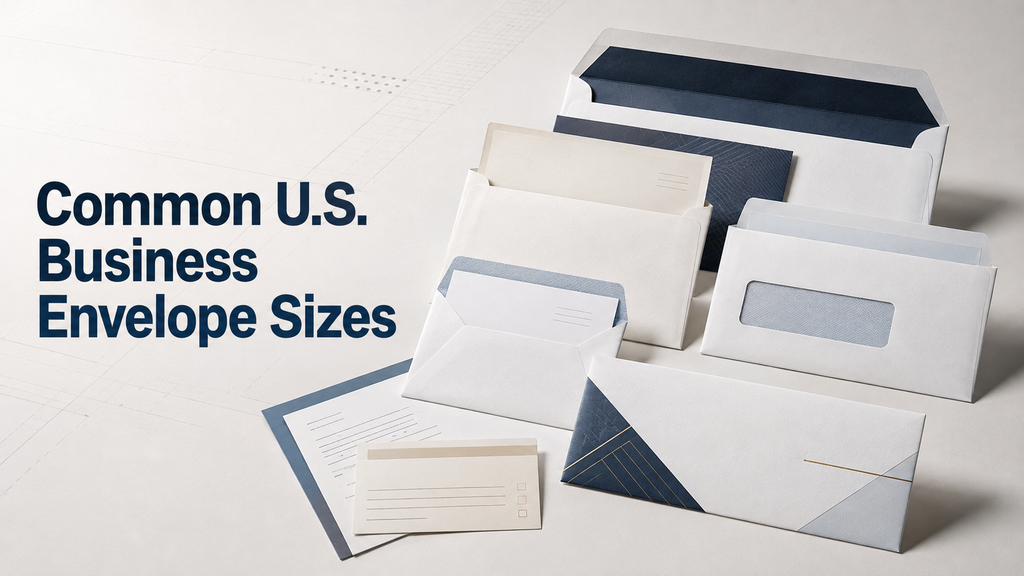
#10 envelope: 4 1/8 × 9 1/2 inches
The #10 is the most familiar business envelope in the United States. It is designed for an 8.5 × 11-inch sheet folded into thirds. Businesses use it for invoices, contracts, statements, direct-mail letters, checks, and everyday correspondence.
A #10 envelope is a strong choice when the mail piece needs to look familiar, fit standard office documents, and remain suitable for regular letter mail. A window version can position the recipient’s address for faster processing, while a solid front provides more room for branding or a designed mailer face.
#9 envelope: 3 7/8 × 8 7/8 inches
The #9 is commonly used as a reply envelope inside a larger mailing. Its compact profile works well for return payments, response cards, donation mail, and forms. When it is inserted into a #10 outer envelope, it creates a convenient two-envelope mailing system.
#6 3/4 envelope: 3 5/8 × 6 1/2 inches
The #6 3/4 format is useful for smaller correspondence and remittance pieces. It is more compact than a #9 and can be appropriate for short notices, small statements, or personal mail where a full business envelope would feel oversized.
Invitation and Greeting Card Envelope Sizes
Invitation envelopes are chosen by the finished size and thickness of the card, not just by the flat paper size. A folded invitation may need extra clearance for layers, ribbon, mounted inserts, or embellishments.
| Finished insert | Suitable starting envelope | Best suited for |
| 4 × 5.25 inches | A2 | Thank-you notes and small cards |
| 4.25 × 5.5 inches | A2 or slightly larger custom size | RSVP cards and small invitations |
| 5 × 7 inches | A7 | Wedding invitations, announcements, and greeting cards |
| 5.5 × 8.5 inches | A9 or custom size | Large invitations and photo mailers |
| 6 × 6 inches | 6 × 6 square | Square cards, luxury invitations, and promotions |
For premium invitations, consider a heavier cardstock, a colored envelope, a lined interior, foil stamping, embossing, or a custom closure. These features affect the final thickness, so test the complete assembled piece before placing a large order.
ISO and International Envelope Sizes
ISO envelope formats are based on the A-series paper sizes. The C-series envelope is sized to hold the corresponding A-series sheet, with enough room for insertion. This makes the system useful for international stationery and cross-border print campaigns.
- C4: 229 × 324 mm. Holds an unfolded A4 sheet.
- C5: 162 × 229 mm. Holds an unfolded A5 sheet or an A4 sheet folded in half.
- C6: 114 × 162 mm. Holds an A6 sheet or an A5 sheet folded twice.
- DL: 110 × 220 mm. Commonly holds an A4 sheet folded into thirds.
- C7: approximately 81 × 114 mm. Suited to compact notes and small cards.
U.S. and international formats are not interchangeable by name alone. If a project will be printed or mailed in more than one country, list the actual finished dimensions and confirm the postal requirements for each destination.
Large, Legal, and Booklet Envelopes
A large envelope is useful when a document should remain flat or when several inserts must be mailed together. Common examples include 9 × 12-inch catalog envelopes and 9.5 × 15-inch legal envelopes. The right selection depends on the document’s final size, thickness, and protection requirements.
A booklet envelope usually opens on the long side and is designed for brochures, catalogs, booklets, and multi-page marketing pieces. A 6 × 9-inch format is a common starting point for smaller booklets, but a thicker insert may require a gusseted or custom-size mailer.
Legal documents deserve special attention. A legal-size sheet measures 8.5 × 14 inches, so a legal envelope must provide sufficient internal clearance to prevent folded corners. If the document must stay completely flat, measure the document stack and select the envelope from the actual finished dimensions rather than from the paper name alone.
How to Select the Right Envelope Size
1. Measure the finished insert
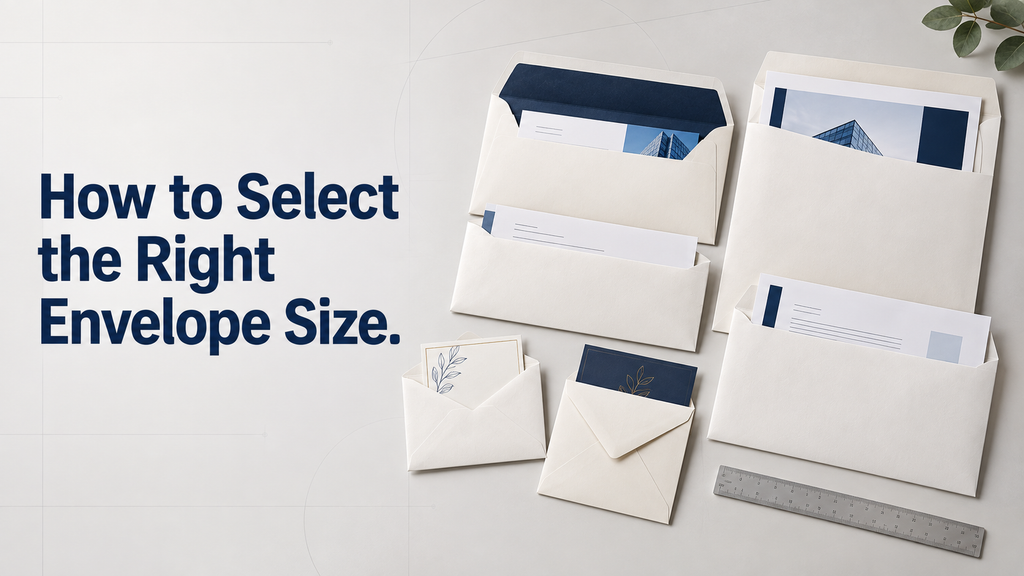
Measure the document after folding, mounting, or assembling it. Record its width, height, and thickness. Include reply cards, backing boards, ribbons, or other components that will travel inside the envelope.
2. Decide whether the insert should be folded
A #10 envelope is efficient for a standard letter folded into thirds. A C4 envelope is better when an A4 sheet must remain flat. If folding would damage the document or reduce its perceived value, choose the larger format.
3. Allow practical clearance
The insert should slide in and out smoothly without being loose enough to shift excessively. Thick paper, multiple inserts, or a flap with a deep adhesive area can reduce usable capacity. A physical mockup is the safest way to confirm fit.
4. Check the mailing category
Envelope dimensions alone do not guarantee a particular postage rate. Shape, thickness, weight, flexibility, and address placement can also affect how a mail piece is classified. For U.S. mail, review the current requirements from theUSPS Postal Explorer before finalizing a large campaign.
5. Match the format to the communication
A #10 envelope communicates routine business correspondence. A square or oversized envelope can make a promotional or event piece feel more distinctive, but it may require additional postage or handling. Select the format that supports both the message and the distribution plan.
6. Plan the artwork around the finished size
Keep critical text, logos, and address areas away from folds, seams, flaps, and trim lines. Ask the printer for a dieline or print template before designing. This is especially important for custom shapes, window envelopes, foil, spot UV, and embossed details.
Envelope Materials, Printing, and Finishes
Envelope performance and appearance depend on more than dimensions. Lightweight paper can work well for routine correspondence, while thicker cardstock creates a more substantial invitation or promotional mailer. Kraft and recycled stocks support an organic brand presentation. Smooth coated stocks are useful when crisp color and refined finishing are priorities.
ZK Print Solutions can produce custom envelopes in a wide range of sizes and shapes, with options including CMYK printing, specialty colors, foil stamping, embossing, debossing, spot UV, gloss or matte finishes, soft-touch lamination, die cutting, gluing, scoring, and perforation. For a premium first impression,custom foiled envelopes from ZK Print Solutions can highlight a logo, invitation lettering, or key brand detail with metallic shine.
The production process should begin with a clear specification: finished dimensions, paper stock, quantity, closure style, print coverage, finishing, and delivery deadline. A flat proof or 3D mockup helps confirm the design before production.
Frequently Asked Questions
What is the most common business envelope size?
The #10 envelope, measuring 4 1/8 × 9 1/2 inches, is the most common U.S. business format. It typically holds a letter-size sheet folded into thirds.
What envelope fits a 5 × 7 invitation?
An A7 envelope measuring approximately 5.25 × 7.25 inches is a common choice for a 5 × 7-inch invitation. Allow additional room if the invitation is thick or includes multiple inserts.
What envelope holds an unfolded A4 document?
A C4 envelope, approximately 229 × 324 mm, is designed to hold an unfolded A4 sheet. A U.S. 9 × 12-inch envelope may also work depending on the exact document and clearance needed.
Should I use a standard or custom envelope?
Use a standard format when the insert and mailing process are conventional. Choose a custom envelope when the document has an unusual size, the design requires a distinctive shape, or the envelope itself is part of the brand experience.
How can I avoid choosing the wrong size?
Measure the complete finished insert, check the inside dimensions, account for thickness and finishing, and test a physical sample. This simple process is more reliable than selecting an envelope based only on a paper-size label.
Create Envelopes That Fit Your Message and Your Brand
The best envelope is not simply the one that fits the paper. It is the one that protects the contents, works with the mailing method, and presents the brand with the right level of clarity and distinction. For routine letters, the #10 remains a dependable choice. For cards, invitations, catalogs, and premium campaigns, the correct size and finish can make the mail piece feel intentional from the moment it is received.
If you need help selecting dimensions, paper, printing, or finishing,request a custom quote from ZK Print Solutions. The team offers low minimums, free 3D mockups, free print-ready file setup, and custom packaging and printing support from concept through delivery.