



What Is a Tuck Box? A Beginner’s Guide

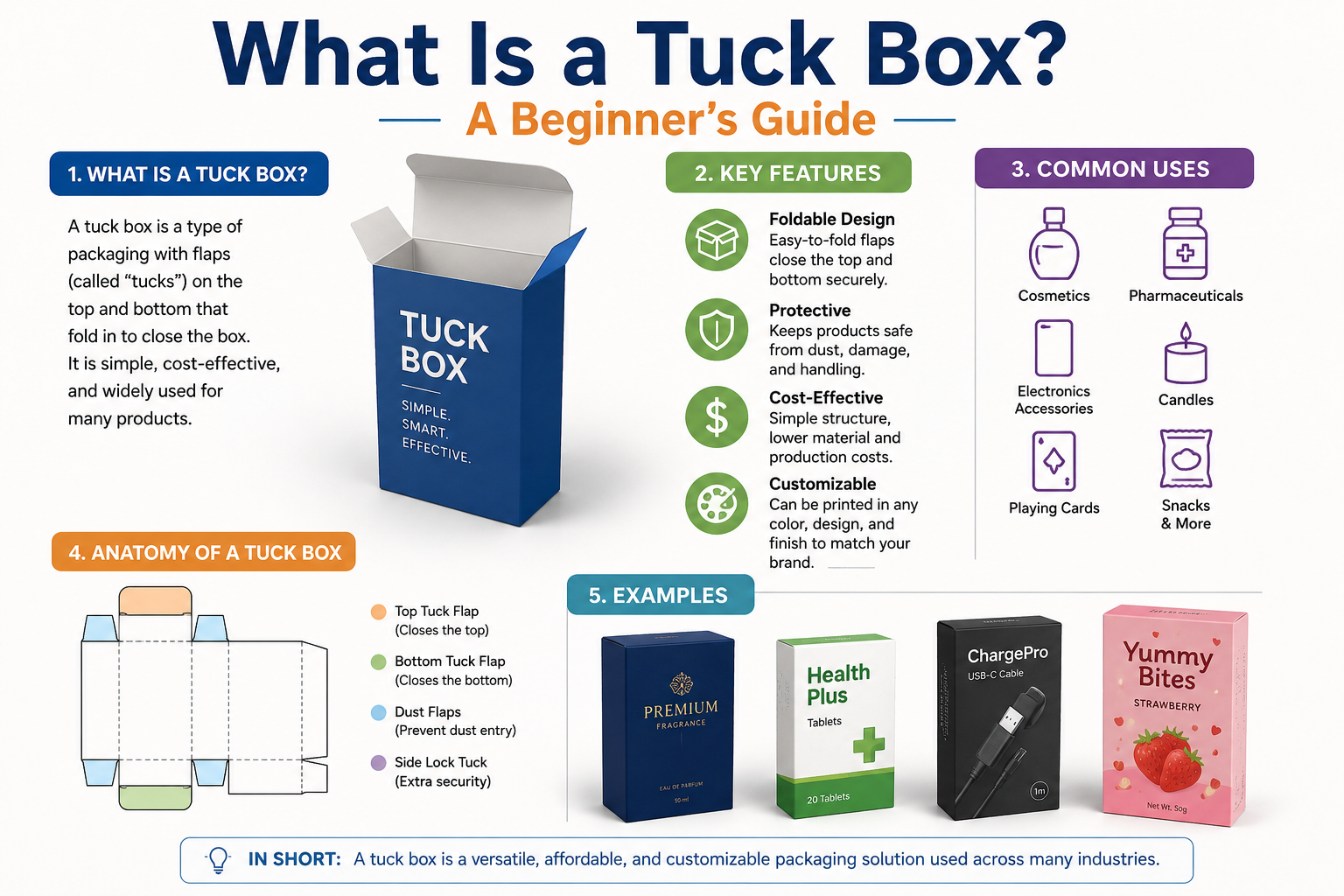
If you’ve ever bought a deck of playing cards, a pack of gum, or a small gift item and noticed the box has flaps that tuck neatly into slots instead of using glue or tape, you’ve held a tuck box. It’s one of the most common — and most overlooked — packaging styles in the world. This guide breaks down exactly what a tuck box is, how it works, why businesses love it, and what you need to know if you’re considering one for your own product.
What Is a Tuck Box?
A tuck box is a type of folding carton made from a single piece of paperboard that closes using flaps which “tuck” into corresponding slots, rather than relying on adhesive, tape, or separate lids. The box is typically die-cut and scored from a flat sheet, then folded into shape. Once assembled, the top (and sometimes bottom) flap slides into a slot cut into the box body, holding the container securely shut.
This simple mechanism makes tuck boxes fast to assemble, easy to open and reclose, and inexpensive to produce at scale — which is why they’re a go-to choice across so many industries.
How a Tuck Box Works
Every tuck box starts as a flat, pre-cut sheet of paperboard called a “blank.” The blank includes:
- Score lines – creased lines that make folding clean and precise
- Die-cut flaps – the tabs that fold down to close the box
- Slots – narrow openings that the flaps slide into to lock the box shut
When the blank is folded along its score lines, it forms a rectangular (or sometimes hexagonal) box. The closing flap is pushed into the slot, creating a snug, tool-free seal. No glue is needed for the closure itself, although the side seams are usually glued during manufacturing to hold the box’s basic shape.
Common Types of Tuck Boxes
Not all tuck boxes are identical. Here are the main variations you’ll come across:
1. Straight Tuck End (STE)
Both the top and bottom flaps tuck in the same direction. This is the most economical and widely used style, common for cigarette packs, playing cards, and small retail items.
2. Reverse Tuck End (RTE)
The top and bottom flaps tuck in opposite directions. This style is a bit more visually distinctive and is popular for cosmetics, supplements, and premium snack packaging.
3. Auto-Bottom (Snap-Lock) Tuck Box
The bottom locks into place automatically when the box is popped open, speeding up assembly for high-volume packing lines.
4. Sleeve-Style Tuck Box
Sometimes paired with an inner tray, this style slides open like a matchbox while still using a tuck mechanism for extra security.
What Are Tuck Boxes Used For?
Tuck boxes show up in far more places than most people realize:
- Playing cards and card games – the classic use case
- Tarot and oracle decks
- Tea bags and coffee sachets
- Cosmetics and skincare (lip balm, small serums, sample kits)
- Supplements and pharmaceuticals (blister pack cartons)
- Food and snack packaging (candy, gum, small bakery items)
- Small electronics and accessories (earbuds, cables, SD cards)
- Gift and jewelry packaging
Their compact, secure design makes them ideal for lightweight products that need protection without bulky packaging.
Materials Used to Make Tuck Boxes
Most tuck boxes are made from one of the following:
- SBS (Solid Bleached Sulfate) paperboard – bright white, smooth finish, ideal for high-quality printing
- Kraft paperboard – natural brown look, popular for eco-friendly or rustic branding
- Recycled paperboard – budget-friendly and sustainable, though slightly less rigid
Thickness is usually measured in points (pt) or GSM (grams per square meter), with common ranges between 12pt–24pt (300–600 GSM) depending on how sturdy the box needs to be.
Benefits of Using Tuck Boxes
1. Cost-Effective Because they’re made from a single die-cut sheet with minimal material waste, tuck boxes are one of the cheapest custom packaging options available, especially at scale.
2. Lightweight and Space-Efficient They flat-pack for shipping and storage, which saves on freight and warehouse costs before assembly.
3. Easy to Brand The flat surface area is perfect for full-color printing, foil stamping, embossing, or spot UV — giving small businesses an affordable way to create premium-looking packaging.
4. Quick Assembly No glue guns or extra hardware required. Tuck boxes can be folded and closed by hand in seconds, which is great for small-batch or handmade product businesses.
5. Reusable and Resealable Unlike glued or sealed boxes, tuck boxes can be opened and closed repeatedly without damaging the box, making them user-friendly for items used over time (like card decks or gum).
Tuck Box vs. Other Folding Cartons
| Feature | Tuck Box | Glued Carton | Rigid Box |
| Closure | Flap tucks into slot | Glued shut | Separate lid |
| Cost | Low | Low–Medium | High |
| Reusability | High | Low | High |
| Assembly | Manual, fast | Machine-glued | Manual, slower |
| Best for | Small, lightweight items | Sealed retail products | Premium/luxury goods |
How to Choose the Right Tuck Box for Your Product
If you’re deciding whether a tuck box is right for your packaging needs, consider:
- Product weight and fragility – Tuck boxes work best for lightweight, low-to-moderate fragility items.
- Reusability needs – If customers will open and close the box repeatedly (like a deck of cards), a tuck box is ideal.
- Branding goals – Since the box is essentially a blank canvas, think about finishes like matte lamination, foil accents, or embossing to elevate perceived value.
- Budget – Tuck boxes are one of the most economical custom packaging formats, making them a smart choice for startups and small print runs.
- Sustainability – Choose recyclable or Kraft paperboard if eco-friendly packaging is a priority for your brand.
Final Thoughts
A tuck box might seem like a small detail, but it plays a big role in how a product looks, feels, and functions once it’s in a customer’s hands. Its simple fold-and-tuck design offers an ideal mix of affordability, durability, and branding potential — which is exactly why it remains one of the most popular packaging formats across industries, from card games to cosmetics. Whether you’re packaging a product for the first time or rethinking your current packaging strategy, understanding how a tuck box works is the first step toward choosing the right fit for your brand.
Frequently Asked Questions
Is a tuck box the same as a cardboard box?
Not exactly. While both are made from paperboard-based materials, a tuck box refers specifically to a folding carton with a tuck-flap closure, whereas “cardboard box” is a broader term that can include corrugated shipping boxes, glued cartons, and more.
Can tuck boxes be custom printed?
Yes. Tuck boxes are one of the most popular formats for custom printing because their flat panels are easy to design for and print using offset or digital printing.
Are tuck boxes eco-friendly?
They can be. Many tuck boxes are made from recyclable or biodegradable paperboard, and because they use minimal material, they generally have a smaller environmental footprint than plastic or rigid packaging.
What size are standard tuck boxes?
Sizes vary widely by product. A standard playing card tuck box is typically around 2.5″ x 1″ x 3.5″, but custom dimensions are common depending on what’s being packaged.