



Baseball Card Size: Standard Dimensions in Inches and Millimeters

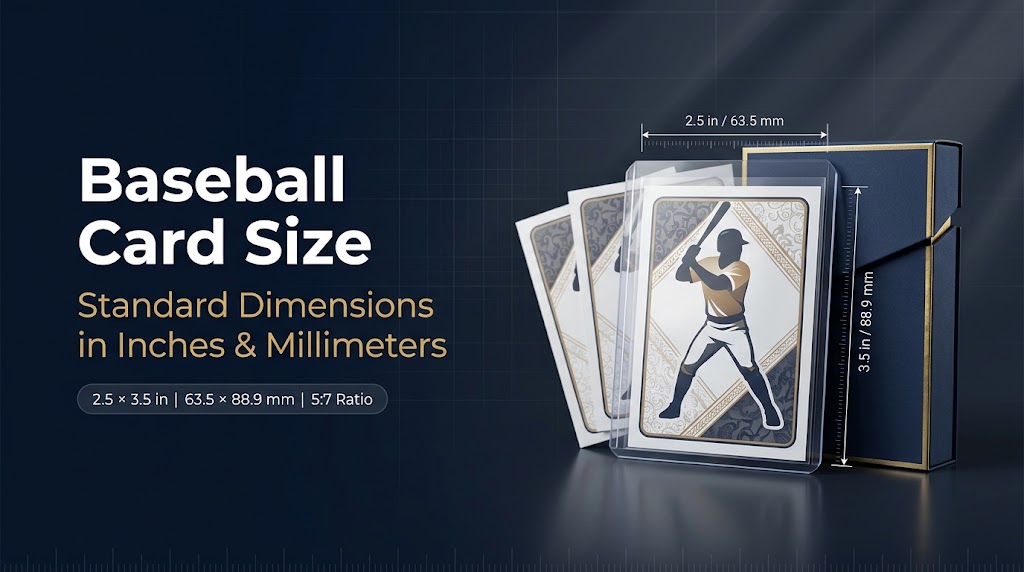
Baseball card size comes down to one portrait format: 2.5 inches wide by 3.5 inches tall, or 63.5 x 88.9 mm. Topps moved to it in 1957, and most US sports cards have followed it since.
Use the numbers below when you set up card artwork, pick a holder or work out the depth of a box.
What Size Is a Baseball Card in Inches, mm and Pixels?
Every unit below describes the same baseball card size. Width comes first, height second, and you read the card upright. The pixel row uses 300 DPI (dots per inch), the usual resolution for print artwork: 2.5 in x 300 = 750 px and 3.5 in x 300 = 1,050 px.
| Unit | Width | Height |
|---|---|---|
| Inches | 2.5 in | 3.5 in |
| Millimeters | 63.5 mm | 88.9 mm |
| Centimeters | 6.35 cm | 8.89 cm |
| Pixels at 300 DPI | 750 px | 1,050 px |
The aspect ratio is 5:7 (2.5 divided by 3.5 is about 0.714). Artwork you scale for this card must keep that ratio, or it will stretch or crop.
Older listings write fractions: 2 1/2 x 3 1/2 inches is the same baseball card size in inches, written the old way.
Why Is 2.5 x 3.5 Inches the Standard Baseball Card Size?
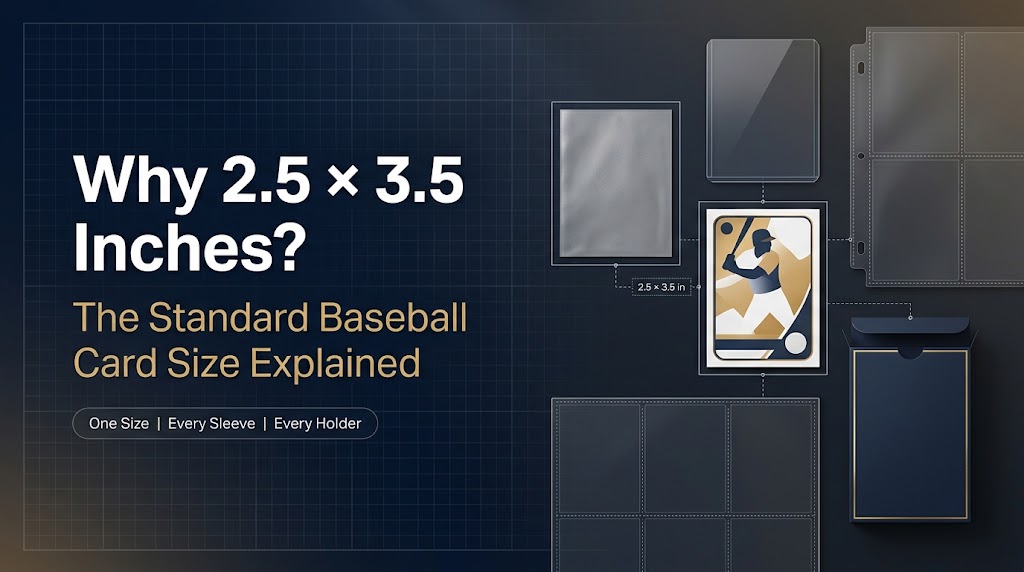
Because most major card makers follow one size, the accessories follow it too. Makers build penny sleeves, toploaders and binder pages around 2.5 x 3.5 inches, so a modern card from a major brand fits the same holders.
Earlier sets used other sizes, covered in the next section. For a packaging buyer, a fixed card size is the stable starting point for every box calculation that follows.
Are All Baseball Cards the Same Size? Vintage, Mini and Oversized Variations
No. The modern format is a standard, not a law, and older or special issues differ. The sizes below come from collector references, with the sources’ own fractions. The millimeter column converts those inches.
| Era or issue | Size in inches | Size in mm | Note |
|---|---|---|---|
| Modern standard (1957 to present) | 2 1/2 x 3 1/2 | 63.5 x 88.9 | Fits standard sleeves and holders |
| Topps, 1952 to 1956 | 2 5/8 x 3 3/4 | 66.7 x 95.3 | Larger than today’s card |
| Goudey, 1930s | 2 3/8 x 2 7/8 | 60.3 x 73.0 | Shorter than today’s card |
| Tobacco-era cards | about 1 3/8 to 1 7/16 x 2 5/8 | about 35 to 36.5 x 66.7 | Sources differ slightly |
| Mini and oversized issues | Varies by set | Varies by set | No single figure applies |
Mini and Oversized Cards: Measure Instead of Guessing
Published figures for mini, oversized and jumbo cards conflict from one source to the next, so there is no honest single number.
Lay the card flat against a ruler and record width and height to the nearest millimeter. That measurement, not a catalog label, is what a holder or box has to fit.
How Thick Is a Baseball Card?
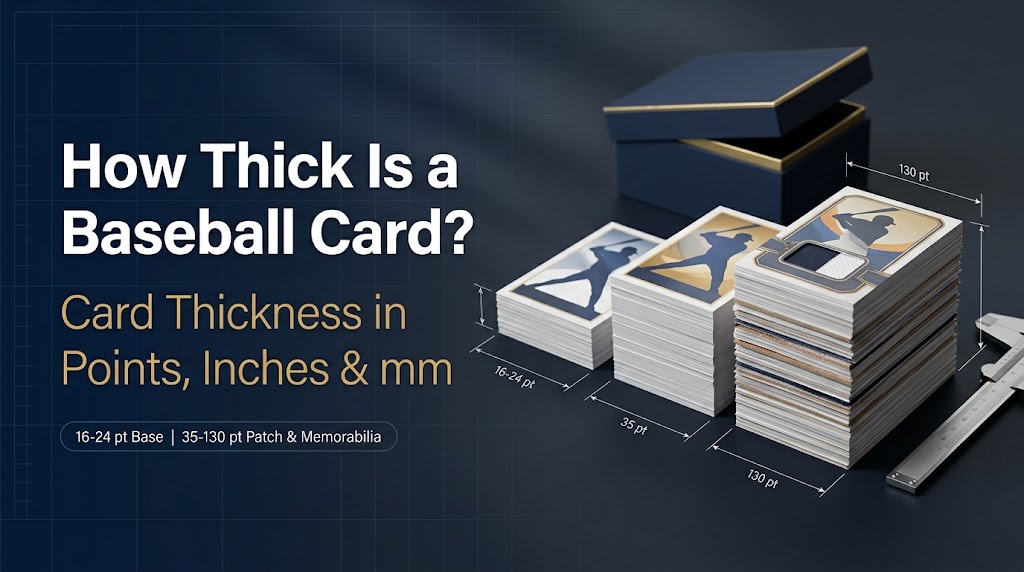
Most sources cover thickness less often than width and height, yet it drives box depth. Card makers measure thickness in points, where 1 pt equals 0.001 inch. Do not confuse it with gsm, which measures paper weight per square meter, not thickness.
- Modern base cards: commonly 16 to 24 pt, which is 0.016 to 0.024 in or about 0.4 to 0.6 mm.
- Patch, autograph and memorabilia cards: from 35 pt (about 0.9 mm) up to 130 pt or more (about 3.3 mm).
A stack of 50 base cards at 20 pt is 1.0 inch deep (50 x 0.020 in). The same 50 cards at 130 pt stack 6.5 inches deep (50 x 0.130 in).
Thickness multiplied by card count gives the inner depth a box maker needs, which is why it returns in the packaging section below.
How Does Baseball Card Size Compare With Other Trading Cards?
Trading card size varies by game and sport, but the main formats sit close together. Pokemon and Magic: The Gathering cards are 63 x 88 mm, practically the same as a baseball card. Yu-Gi-Oh! cards are smaller at 59 x 86 mm and need different sleeves.
| Card family | Size in mm |
|---|---|
| Baseball and sports cards | 63.5 x 88.9 |
| Pokemon and Magic: The Gathering | 63 x 88 |
| Yu-Gi-Oh! | 59 x 86 |
The gap between a baseball card and a Pokemon or Magic card is 0.5 mm in width and 0.9 mm in height, which matters for tight-fitting holders.
For poker, bridge and other deck formats, see our guide to playing card dimensions.
What Sizes Do Cards Need in Sleeves, Toploaders and Cases?
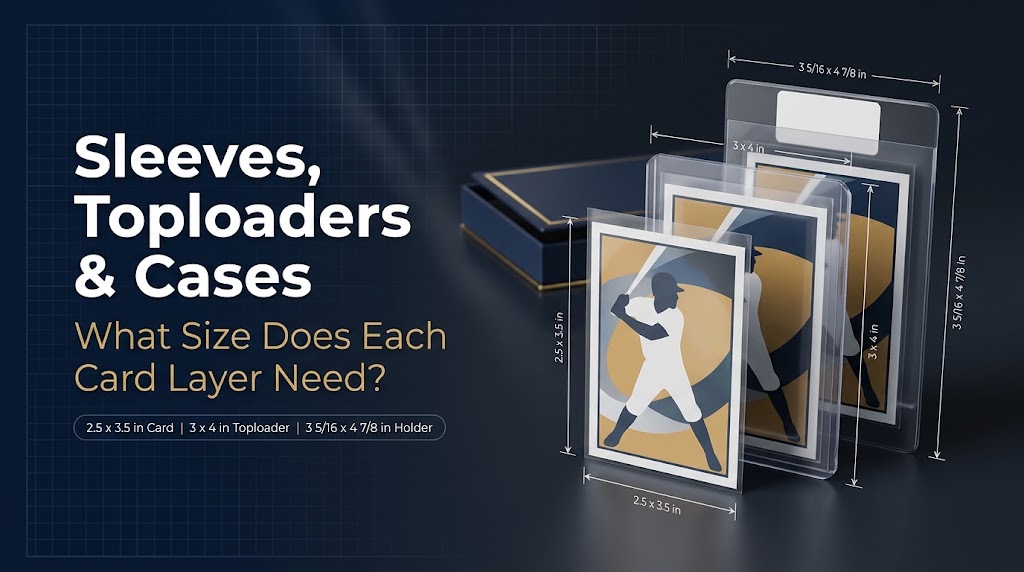
Cards are often stored in a protective layer, and that layer sets the real footprint. Standard cards fit penny sleeves, toploaders and binder pages. A common 3 x 4 inch toploader holds standard cards up to 35 pt.
Semi-rigid holders for grading submissions are commonly sold at 3 5/16 x 4 7/8 inches. Cards outside the standard size usually need custom-size sleeves or toploaders.
| Layer | Outer footprint (inches) | Outer footprint (mm) | Note |
|---|---|---|---|
| Bare card | 2.5 x 3.5 | 63.5 x 88.9 | Standard format |
| Toploader | 3 x 4 | 76.2 x 101.6 | Standard cards up to 35 pt |
| Semi-rigid holder | 3 5/16 x 4 7/8 | 84.1 x 123.8 | Varies by seller |
Other companies make these holders; the table lists them only as sizing references. Check the dimensions of the exact product you plan to use, because sellers differ.
How to Size a Custom Card Box or Display Box Around Baseball Cards
For a look at a card-game box in production, our custom card boxes page shows the nearest standard product, and more formats sit under sports packaging.
The baseball card size is the starting point for a box, not the answer. Measure the box from what actually goes inside it.
Start From the Holder, Not the Card
Decide whether the box holds bare cards, sleeved cards, toploaders or semi-rigid holders. Take the footprint from the holder table above, because the holder is wider and taller than the card inside it.
Work Out Stack Depth
Multiply thickness in points by card count, then add the depth of any holder layers. A box for toploaders needs more depth than a box for the same number of bare cards.
| Example | Thickness | Footprint (W x H) | Depth before clearance |
|---|---|---|---|
| 50 base cards | 20 pt (0.020 in) | 2.5 x 3.5 in | 1.0 in |
| 50 patch or memorabilia cards | 130 pt (0.130 in) | 2.5 x 3.5 in | 6.5 in |
Add Fit Clearance
The inner dimensions must be slightly larger than the stack so cards slide in and out without scraping the edges. Too tight and the box is hard to load; too loose and cards shift in transit. Ask the manufacturer which clearance suits the board and closure you choose.
Set Orientation and Count
State whether cards stand on edge or lie flat, and how many go in each box. A display box that shows cards upright needs different dimensions from a flat-pack carton.
Artwork Size and Bleed
Print files for the card itself should match the 750 x 1,050 px, 300 DPI figure above, while box artwork follows the box’s finished size.
Ask your supplier what bleed (the extra print area beyond the trim edge) and safe margin their process needs. Our dieline guide explains cut, fold and bleed lines and the safe margin on a box template.
From Dimensions to Production
Two steps help once the dimensions are set: a 3D mockup of the box, and a digital proof before printing.
What to Send a Packaging Manufacturer
A complete first message saves a round of questions. These are the details that fix the dimensions:
- Inner length, width and depth, in inches or millimeters.
- Holder type: bare, sleeved, toploader or semi-rigid.
- Card thickness in points and the number of cards per box.
- Upright or flat orientation.
- Your order size. ZK Print Solutions has no minimum order.
- The card images or artwork you plan to show on the box.
FAQ
Is a Topps card the same size as other brands?
Yes, modern Topps cards share the 2.5 x 3.5 inch footprint of other major brands.
Is 4 x 6 or 5 x 7 a baseball card size?
No. Those are photo print sizes. A card listed that way is a photo or display print, not a standard baseball card.
How do I work out the pixel size for any card?
Multiply each dimension in inches by 300 for a 300 DPI file. A vintage 2 5/8 x 3 3/4 inch card comes to about 788 x 1,125 pixels (2.625 x 300 and 3.75 x 300).
Does a thick memorabilia card fit a standard toploader?
Often not. A 3 x 4 inch toploader holds cards up to 35 pt, while patch and autograph cards run from 35 pt to 130 pt or more, so the thickest ones need another holder.
How do I describe a non-standard card size when asking for a custom box?
Measure the card as described under mini and oversized cards above, and give the exact size, holder type and card count when you ask for a custom box quote. There is no minimum order.
Custom boxes are quoted from your inner dimensions and card count, so send both through the quote form to Get a Free Quote. You can also call +1 346-350-1186 or email magnuswolfson@zkprintsolutions.com.