



What Is a Corrugated Box? Layers, Flutes and Strength Ratings

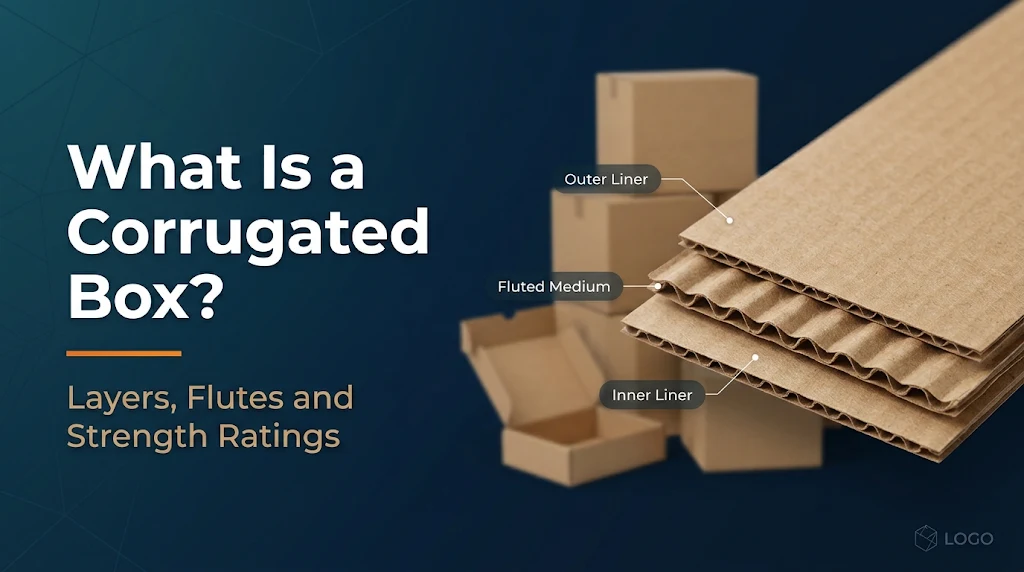
What is a corrugated box? It is a box made from corrugated board: a wavy sheet of paper, called the medium, glued between two flat sheets, called liners. The waves form arches, and the arches let the board resist crushing and absorb knocks.
That one idea explains most of what you will see on a box spec. The size of the waves, the number of wavy layers and the test rating all describe how much load and handling the box can take.
What Is a Corrugated Box Made Of? Three Layers
People often say “cardboard” for any brown box. In packaging terms, corrugated cardboard has three parts:
- Outer liner. The flat face you see and print on.
- Medium. The fluted, wave-shaped sheet in the middle.
- Inner liner. The flat face inside the box.
Liners made mostly from virgin fiber, called kraft liners, are stiffer and take print well.
Test liners contain more recycled fiber. They are weaker and give a rougher print surface.
A folding carton, like a cosmetic or food box on a shelf, is different. It is a single, solid sheet of paperboard with no wave inside. That is why a retail carton feels thin and smooth, while a shipping box feels thick and springy.
Flute Sizes: The Chart Buyers Ask About
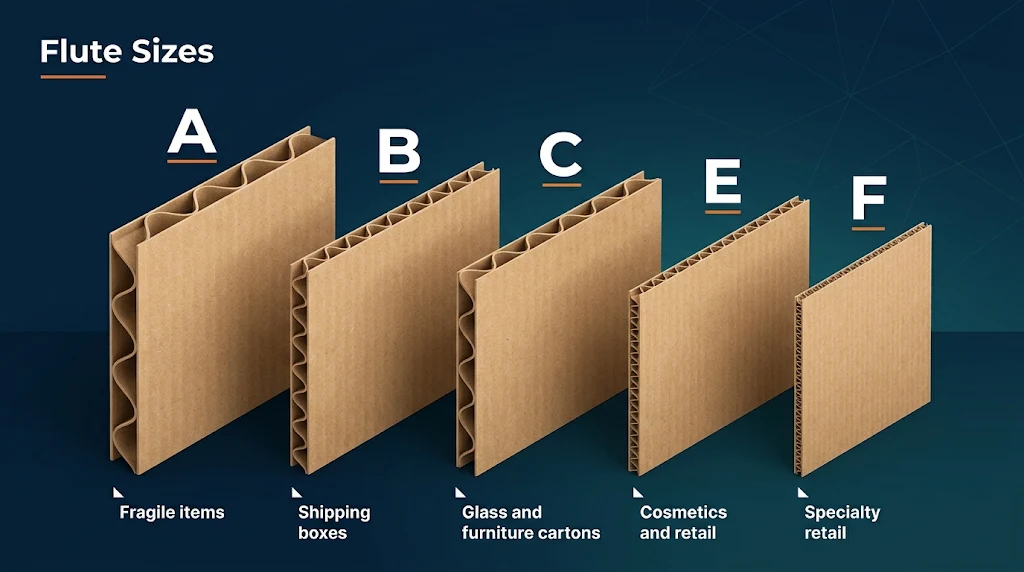
The flute is the wave in the medium. Each flute size has a letter, and the letter tells you roughly how thick the board is and how many waves fit in one foot. Sources do not agree on every figure, so treat the numbers below as typical values, not exact standards.
| Flute | Approx. flutes per foot | Approx. thickness | Common use |
|---|---|---|---|
| A | About 33 | 3/16 in to 1/4 in | Fragile items |
| B | About 47 | 1/8 in | Shipping boxes |
| C | About 39 | 5/32 in to 3/16 in | Glass, dairy and furniture cartons |
| E | About 90 | 1/16 in | Cosmetics and printed retail packaging |
| F | About 125 | 1/32 in | Specialty retail boxes and fast-food clamshells |
For the box styles these flutes are used in, browse our cardboard boxes.
Board thickness changes a little from one mill to the next. To identify a flute, count the waves in one foot of board, because that count stays more consistent than the thickness.
E Flute vs B Flute
Brands that ship and sell in the same box often weigh E flute vs B flute.
- E flute is about half the thickness of B flute and has many more waves per foot. The surface stays flatter, so printed graphics look sharper. It folds more tightly, which suits mailer boxes and tuck end product boxes; our tuck box guide shows how those flaps close.
- B flute is thicker and gives more crush resistance and padding. It suits boxes that travel through carrier networks with heavier contents.
If the box is the first thing a customer opens, E flute often wins. If the box mainly protects a heavy item in transit, B flute is the safer choice. Our E-flute corrugated boxes show how the thinner board takes full-color print.
Single Wall, Double Wall and Triple Wall
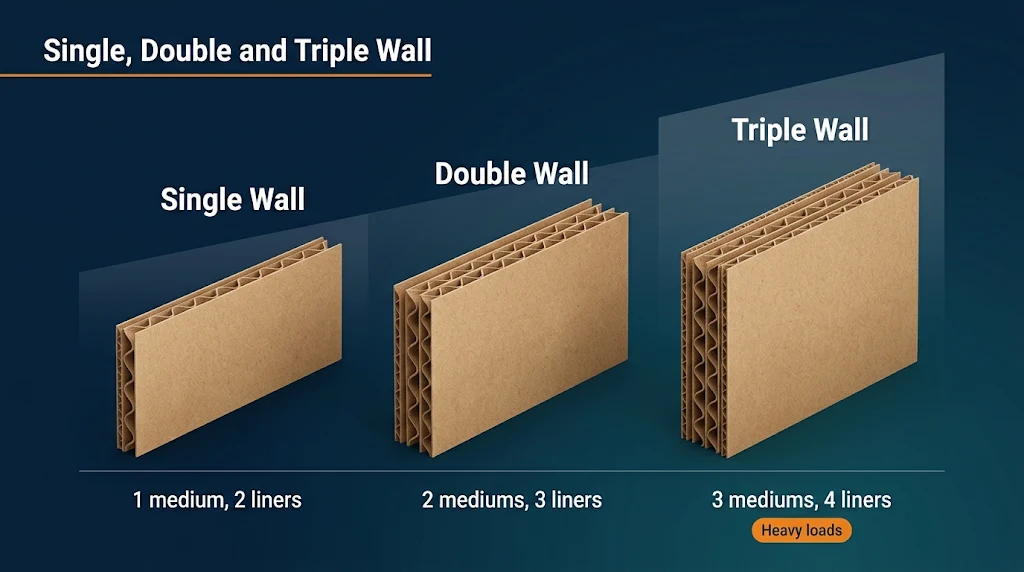
The wall count tells you how many wavy layers the board has.
- Single wall. One medium between two liners. This is the most common corrugated carton box and covers most parcels.
- Double wall. Two mediums and three liners. A common build is BC, a B flute and a C flute together. It is a thicker, stiffer board than single wall.
- Triple wall. Three mediums and four liners. It is used for very heavy or industrial loads, and it is much stiffer and harder to fold.
Each extra wall adds strength but also weight and thickness, so pick the lowest wall count that still protects the product.
ECT and Mullen: Reading the Strength Stamp
Many shipping boxes carry a box maker’s certificate, a printed stamp that shows one of two strength ratings.
- ECT (Edge Crush Test) measures how much force the board takes on its edge before it buckles. It matters most for stacking, when boxes sit on top of each other in a warehouse or a truck.
- Mullen or burst test measures how much force it takes to push through the face of the board. It matters most for rough handling and sharp contents.
A single-wall box rated 200 lb by Mullen is often compared to about 32 ECT, and 275 lb to about 44 ECT. These conversions are rough, because the two tests measure different things. Ask your supplier which test they quote, and compare like with like.
Benefits of Corrugated Boxes
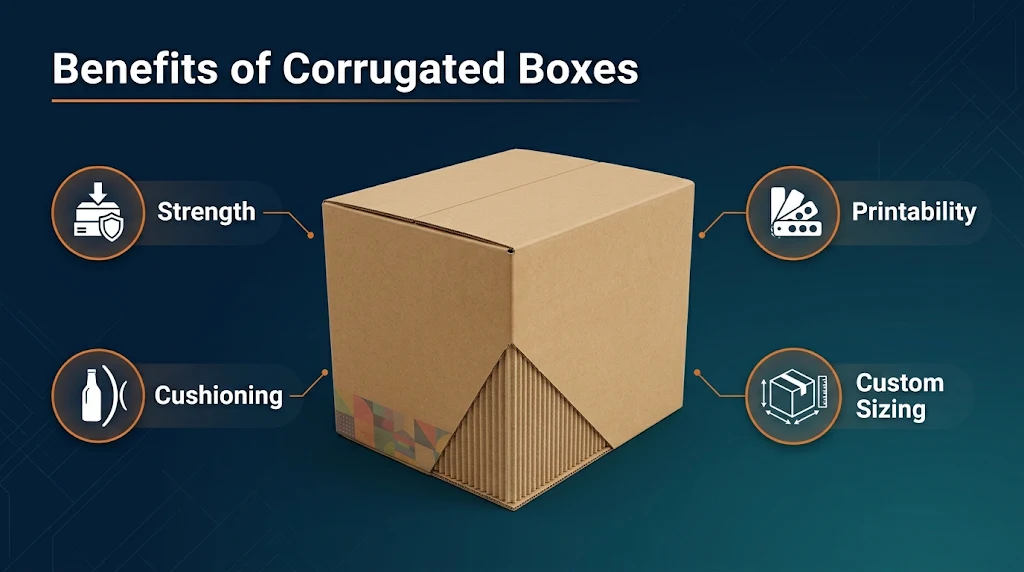
The benefits of corrugated boxes come from the arch structure inside the board:
- Strength. The flutes resist crushing and keep the box square under load.
- Cushioning. The fluted layer helps absorb impacts in transit.
- Printability. Fine flutes like E and F take full-color print, so one box can protect and present the product.
- Custom sizing. The board can be die cut and sized to the product.
Each added wall makes the board thicker and stiffer, and triple wall is the choice for the heaviest loads.
When Another Package Fits Better
Corrugated packaging is not always the right answer. The product and the route it travels decide.
- Retail shelf with light products: a paperboard folding carton is thinner and uses less material.
- Premium gifts and keepsakes: a rigid box made from greyboard wrapped in printed paper feels more solid. See our magnetic closure rigid boxes for that build.
- Soft goods like apparel: a flexible mailer bag is another option. Our custom mailer bags cover that option.
- E-commerce and fragile items: corrugated mailer and shipping boxes combine protection and print.
For delicate items with a tight delivery window, such as fresh flowers, our flower shipping boxes can be made in corrugated stock.
FAQs
What is a corrugated box used for?
Mostly for shipping: e-commerce parcels, large or heavy products, and food such as pizza. Thin E and F flutes also make cosmetic and retail packaging.
Is a corrugated box the same as a cardboard box?
Not exactly. “Cardboard” is an everyday word for many paper-based boxes. Corrugated board has a wavy medium between two liners. A paperboard box, like a cereal carton, is a single solid sheet with no flutes.
Which flute is best for a mailer box?
E flute is a common choice for printed mailer boxes. It is thin enough for clean folds and sharp graphics, but it still gives good protection for light and medium items.
What does 32 ECT mean?
It is the board’s Edge Crush Test rating, given in pounds per inch of edge, for the force the board takes before it buckles. A 32 ECT single wall box is the standard grade for everyday parcels.
Can corrugated boxes be printed in full color?
Yes. Fine flutes such as E and F give a smooth surface for CMYK printing, and brand colors can be matched with PMS spot colors.
Get Corrugated Boxes Made for Your Product
Pick the flute for how the box is used, the wall count for the weight, and the rating for how the boxes will stack. We build corrugated mailers and shipping boxes to your size with no minimum order, including design support and a proof before printing. Get a Free Quote, call +1 346-350-1186 or email magnuswolfson@zkprintsolutions.com.