



Face Cards in a Deck: The Complete Guide to King, Queen and Jack

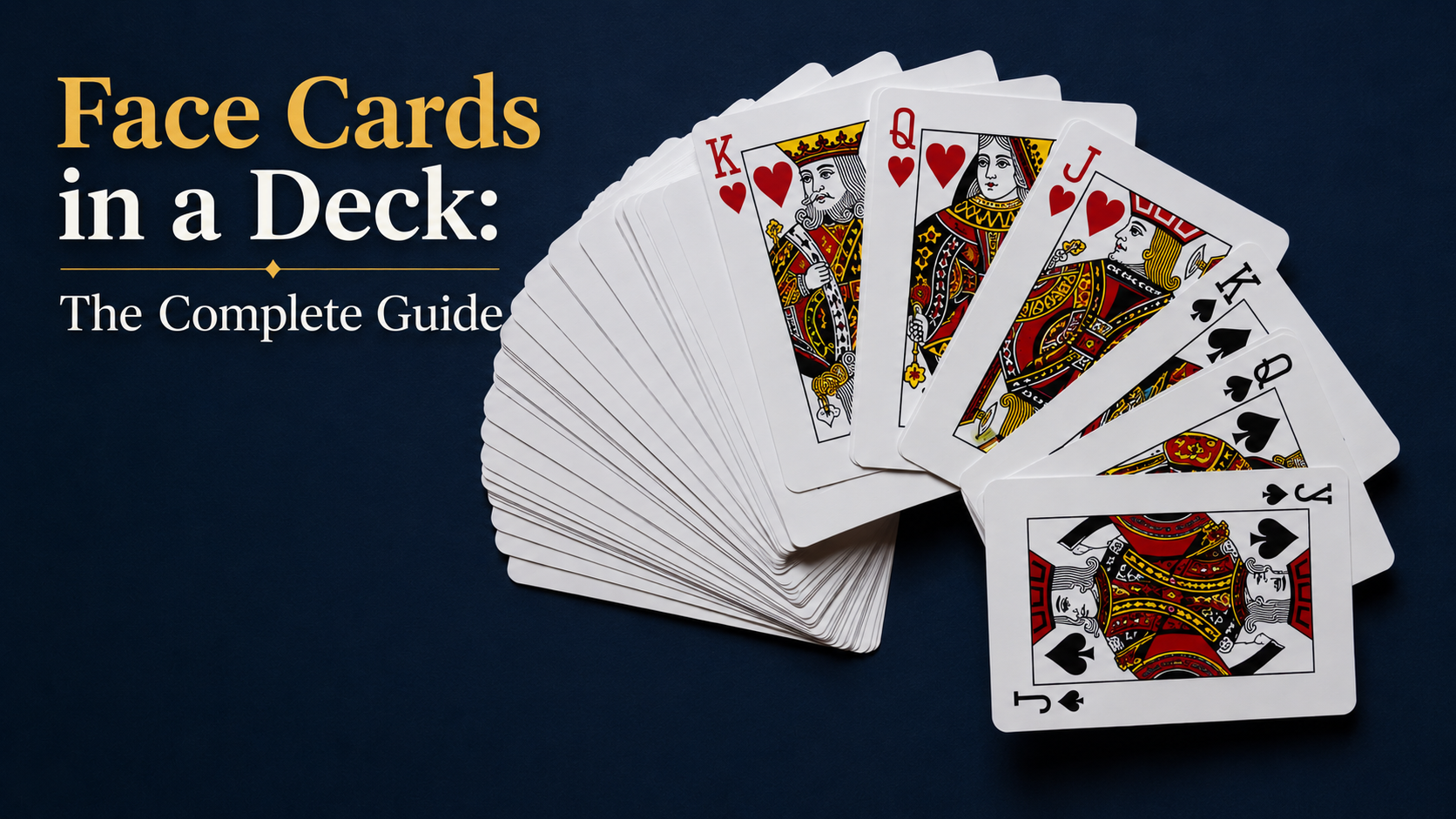
Shuffle any standard deck and three characters keep showing up in every suit: a King, a Queen, and a Jack. Together they are known as face cards, and they carry more history, strategy value, and design weight than most players realize. This guide breaks down what face cards are, how many sit inside a 52 card deck, where their imagery comes from, and why their artwork matters just as much in a printed deck as it does at the poker table.
Whether you are brushing up on the rules before game night or planning acustom playing card printing project of your own, this is everything you need to know about face cards in a deck.
What Are Face Cards in a Deck of Playing Cards?
Face cards, also called court cards or picture cards, are the King, Queen, and Jack in each suit of a standard deck. Unlike number cards, which use pips (repeated suit symbols) to show their value, face cards display an illustrated human figure from the chest up. That single design choice is what separates them from every other card in the deck, including the Ace, which is often mistaken for a face card but carries no portrait at all.
Why Are They Called Face Cards or Court Cards?
The name comes directly from the artwork. Early card makers used royal and courtly figures, kings, queens, and knaves, to give each deck a recognizable hierarchy. That illustrated head and shoulders became the defining feature of the card, so players started calling them face cards. The term court cards traces back to the same idea: these were the cards of the royal court, ranked above the ordinary numbered cards in both status and, in many games, point value.
Because the artwork is so distinct, face cards are also the easiest cards to identify at a glance mid shuffle, which is part of why they still anchor so much of custom deck design today.
How Many Face Cards Are in a Standard 52 Card Deck?
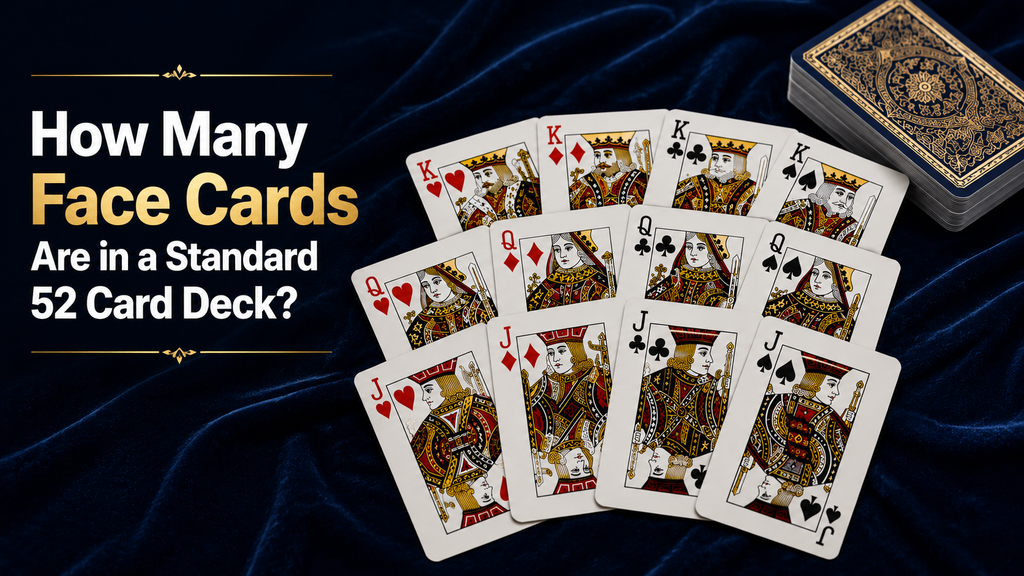
A standard deck contains 52 playing cards split across four suits: hearts, diamonds, clubs, and spades. Each suit holds exactly one King, one Queen, and one Jack, which means:
- 4 suits x 3 face cards per suit = 12 face cards in a full deck.
- 40 number cards, running from 2 through 10 in each suit.
- 4 Aces, which are high value but not classified as face cards.
- 2 Jokers in most commercial decks, though they sit outside the 52 card count.
So out of 52 cards, 12 are face cards, which is roughly 23 percent of the deck.
Face Cards vs Number Cards vs Aces
Here is a quick side by side comparison to clear up the confusion between face cards, number cards, and Aces:
| Feature | Face Cards | Number Cards | Ace |
| Cards included | King, Queen, Jack | 2 through 10 | Ace only |
| Visual design | Illustrated human figure | Pips (repeated suit symbols) | Single large suit symbol |
| Count per suit | 3 | 9 | 1 |
| Total in deck | 12 | 36 | 4 |
| Typical value | High, game dependent | Numeric face value | Highest or lowest, game dependent |
The History Behind Face Cards
Playing cards are believed to have originated in China around 1,000 years ago before making their way to Europe in the 1300s. It was France that standardized the King, Queen, and Jack as we know them, and over time each King in the deck picked up a loose historical or legendary identity. These associations were never officially standardized, and different regions told different versions of the story, but they explain why so muchcustom card and packaging design still borrows from this royal iconography.
King of Hearts
Nicknamed the Suicide King because older woodcut designs showed a sword appearing to run through his head. He is often linked to Charlemagne and is associated with bravery and sacrifice.
King of Diamonds
Known as the Rich King, tied in folklore to Julius Caesar, and associated with wealth and influence.
King of Clubs
Connected to Alexander the Great, this King’s artwork is meant to reflect ambition, strength, and leadership.
King of Spades
Linked to King David, blending wisdom, authority, and responsibility into a single figure.
The Queens and Jacks carry their own folklore too. Historical decks have tied the Queen of Clubs to Judith and the Jack of Diamonds to Hector, among other regional variations:
| Card | Traditional Historical Link |
| King of Hearts | Charlemagne |
| King of Spades | King David |
| Queen of Clubs | Judith |
| Jack of Diamonds | Hector |
None of this is officially confirmed by any card manufacturer, but it shows how much cultural weight got baked into a piece of print production that most people shuffle without a second thought.
The Probability of Drawing a Face Card
If you are trying to work the odds mid game, the math is simple. There are 12 face cards in a 52 card deck, so:
- 12 face cards / 52 total cards = about 23 percent, or roughly 1 in 4.
That probability holds for a single draw from a full, shuffled deck. It shifts as cards are removed from play, which is exactly why card counters and serious players track face cards closely in games like Blackjack and Poker.
How Face Cards Rank Across Popular Card Games
Face card value is not fixed. It changes depending on what you are playing:
- Blackjack: King, Queen, and Jack are each worth 10 points.
- Rummy and Gin Rummy: face cards are typically worth 10 points each.
- Poker: face cards form the backbone of strong hands, including the Royal Flush.
- Euchre: the Jack, called the Bower, can outrank the King and Queen depending on trump suit.
- Bridge: the King is usually one of the strongest cards after the Ace.
- Hearts: the Queen of Spades carries a heavy penalty, making her one of the most feared face cards in the deck.
Understanding how face cards rank in your game of choice is often the difference between playing defensively and playing to win.
Why Face Card Artwork Matters for Custom Card Printing
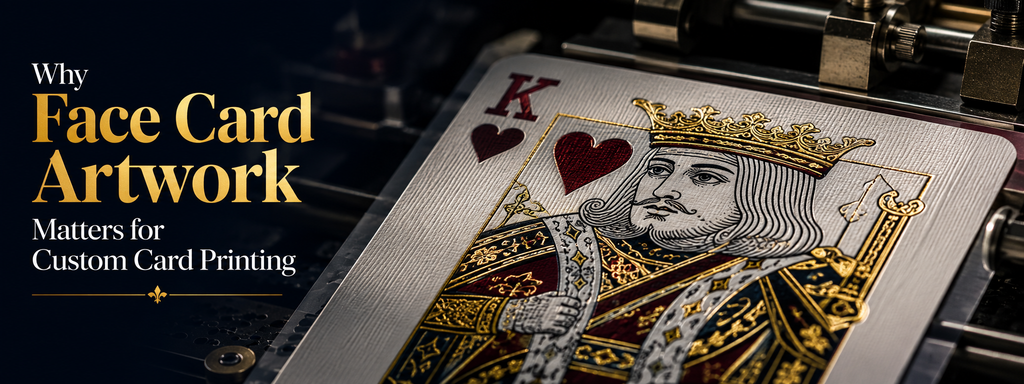
Face cards are the most detailed cards in any deck, which makes them the hardest to get right in production. Fine linework, small color separations, and symmetrical portraits all have to survive high speed cutting and repeated shuffling without cracking, fading, or misaligning. This is exactly the kind of precision that acustom packaging and print partner needs to handle before a single card ships.
If you are designing a themed deck, a promotional card set, or a branded gift item built around a deck of cards, the King, Queen, and Jack are usually the first cards a customer studies. Strong card stock, accurate color matching, and a finish that resists wear all matter more on these three cards than anywhere else in the box.
How to Design and Print Your Own Custom Face Cards
If you want to move from a standard deck to a fully custom one, here is a simple production checklist:
- Start with the story. Decide what your King, Queen, and Jack represent, whether that is a brand mascot, a historical theme, or an original character set.
- Choose the right stock. A heavier, coated card stock holds fine facial detail and resists bending better than standard paper.
- Lock in finishing early. Foil stamping, spot UV, or a matte lamination can make face card artwork pop without slowing production.
- Plan the packaging alongside the deck. A tuck box or a rigid box should echo the same color palette and character work as the cards inside.
- Proof before a full run. Face cards have the most detail on the sheet, so they are the first place a color or alignment issue will show up.
ZK Print Solutions has spent decades refining exactly this kind of detail work acrosscustom packaging,gift packaging, and premium card stock production. If character led design is part of your plan, our recent breakdown ofhow mascot artwork drives packaging performance is a useful companion read, since the same principles that make a mascot recognizable on a cereal box apply to a King or Queen on a playing card.
Final Thoughts on Face Cards in a Deck
A standard deck holds 12 face cards, 40 number cards and Aces, and usually 2 Jokers on the side. Knowing how face cards work, what they represent, and how they rank across different games gives you an edge at the table and a better eye for design if you ever plan to print your own deck.
Ready to turn that idea into a physical product?Get in touch with ZK Print Solutions for custom card stock, finishing, and packaging built around your own King, Queen, and Jack.