



Vape Packaging: Branding Ideas, Design Tips and How to Spot Fake Cart Boxes

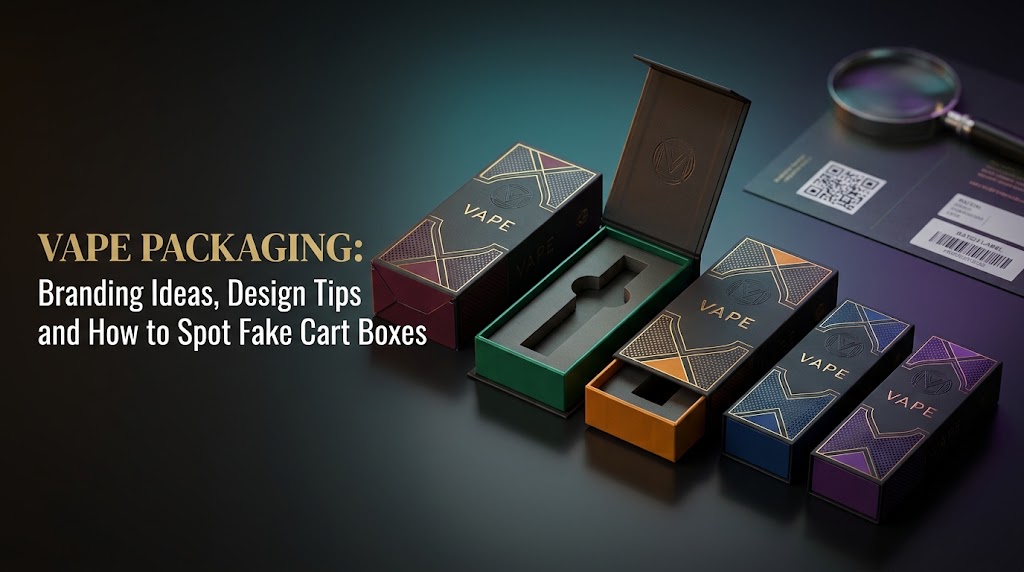
Good vape packaging does three jobs at once: it protects the product, carries the brand, and leaves room for the panel content your market requires. Start with the product format, because the format sets the box structure, and the structure sets how much surface your artwork gets.
A cartridge, a disposable and a pod kit all need different fits. If you already know which format you sell, a printed vape box built around that format is the simplest starting point. The sections below walk through styles, materials, branding, layout, authenticity and ordering in the order most brand teams decide them.
Match the Box Style to the Product Format
The right box style for vape packaging depends on what sits inside, how it is handled and whether it ships or sits on a shelf. The table compares the five formats buyers ask about most.
| Product format | Structure that suits it | Insert | Closure |
|---|---|---|---|
| Cartridge | Folding carton, tuck end | Paperboard slot or cradle that holds the cartridge still | Tuck flap, optional seal |
| Disposable | Folding carton or sleeve over a tray | Die-cut tray sized to the body | Tuck flap or sleeve slide |
| Pod kit | Folding carton or rigid base with lid | Fitted tray for device, pods and cable | Lid, magnetic flap or tuck |
| E-liquid bottle | Tall carton or small rigid box | Collar or divider so the bottle does not shift | Tuck end with tamper seal |
| Starter kit | Rigid two-piece box or large carton | Layered tray for device and accessories | Lid or magnetic flap |
For a premium or gift-style kit, magnetic closure rigid boxes give a firm, reusable case. If you want a keepsake that outlasts the product, tin packaging also works as a durable outer case.
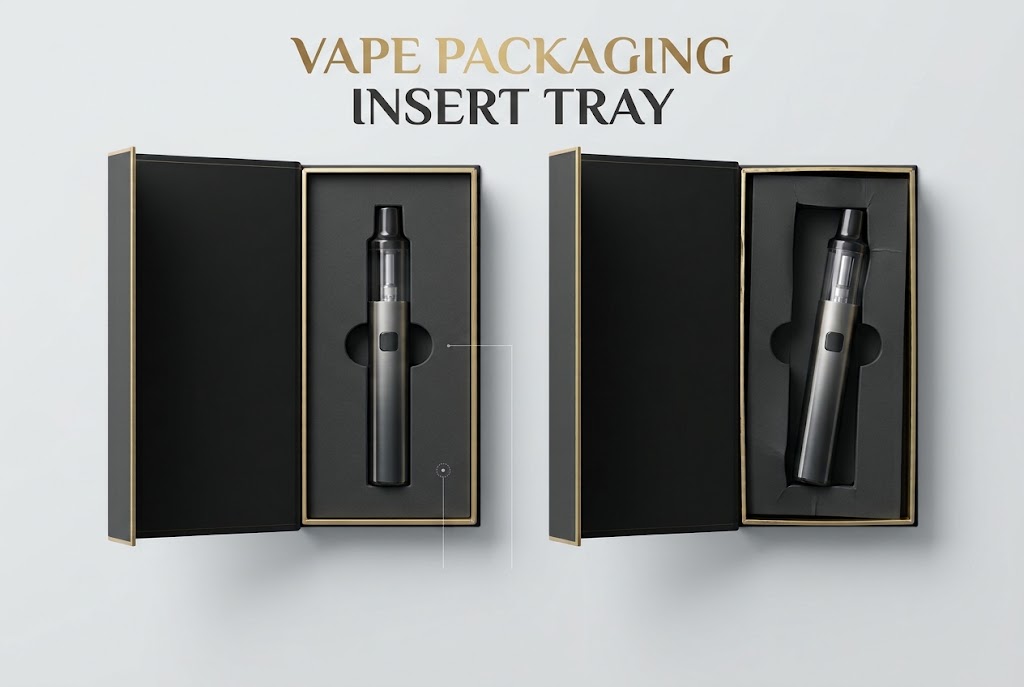
Why the Insert Matters
A snug insert matters more than most brands expect. A device that rattles in transit reads as low quality before the customer sees the artwork.
Materials and Finishes That Carry a Vape Brand
Paperboard folding cartons are the usual choice for retail boxes. They print sharply, fold flat for shipping and suit most cartridge and disposable formats. Rigid board adds weight and a premium feel for kits and gift sets. Corrugated belongs to shipping cartons, not to the retail box itself.
Finishes for a Small Panel
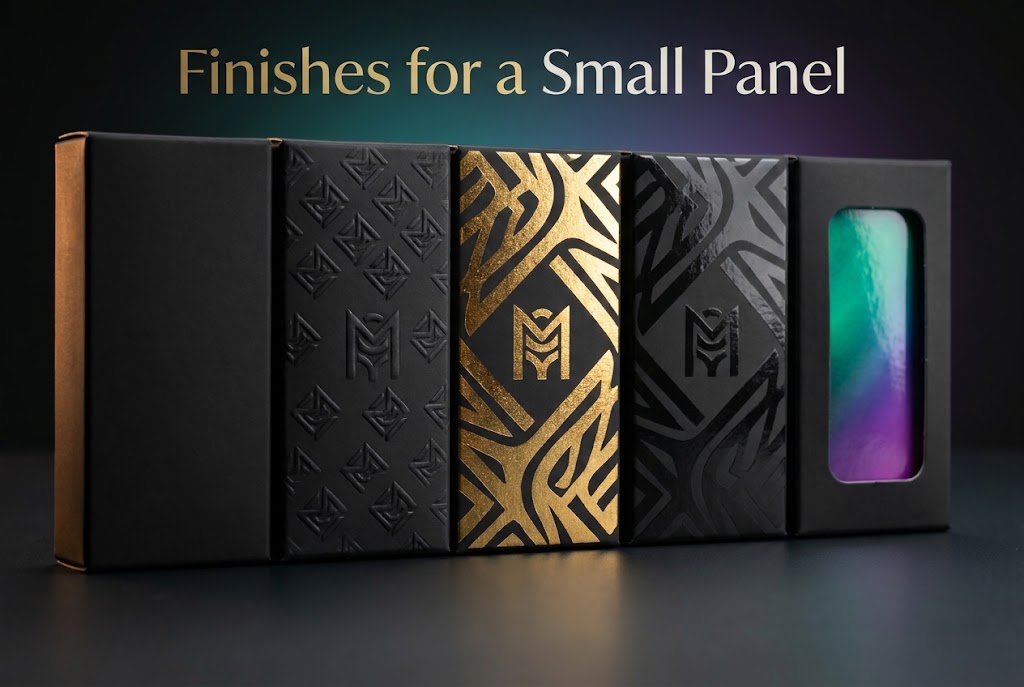
Finishes do the work that a small panel cannot do with ink alone:
- Matte or soft-touch coating gives a smooth, quiet surface that reads as premium.
- Embossing raises a logo or pattern you can feel with a thumb.
- Foil stamping adds a metallic accent to a name or mark.
- Spot UV makes selected areas glossy against a matte field.
- A window cut-out shows the product or a flavor color without extra print.
Trade press has noted a shift toward restrained, typography-led looks in vape packaging, where finish and layout carry the design instead of loud graphics. That direction suits small boxes well.
Vape Branding Ideas That Work on a Small Box
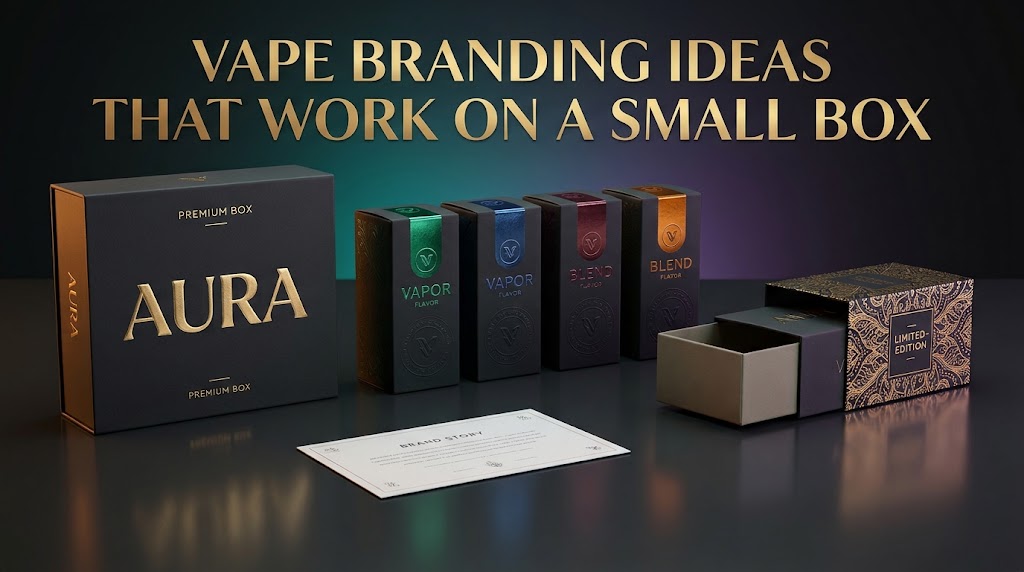
A small box gives you little surface, so each idea has to earn its space. These vape packaging ideas work well on compact panels:
- Typography first. A confident wordmark and a clean type hierarchy can carry the whole front panel.
- One structure, one color or foil per flavor. You keep a single die-line and change only the color or foil for each variant, which keeps tooling simple. A well-known e-liquid design case used this principle with foil colors per flavor.
- Limited editions. A seasonal finish or color on the same base box creates a reason to collect without a new structure.
- Tactile finishes. Soft-touch or embossing makes the box memorable in the hand.
- A sleeve over a plain base. The base stays constant while sleeves change by flavor or campaign.
- A brand story card. A small printed insert tells customers who you are without crowding the pack.
Strong vape branding comes from repeating a few choices consistently, not from adding more of them. Pick a color system, a type pairing and a logo position, then hold them across every pack.
How to Design the Layout Around Required Panel Content
Plan the panel budget before any artwork starts. Warnings, symbols, batch details and manufacturer information differ by market and by product, so confirm exactly what your pack needs with your compliance advisor. We do not set those requirements here, and your box should not be finalized until they are known.
Set the Hierarchy and Protect the Zones
Once you know how much space that content needs, build the layout around it:
- Hierarchy. Put the logo first, then the product name and variant, then supporting details.
- Contrast and legibility. Small type needs strong contrast and a clean background to stay readable at arm’s length.
- Protected zones. Keep decorative art, foil and embossing out of the areas the required content occupies.
Good vape packaging design treats those zones as part of the layout from the first sketch, not as stickers added at the end. A short design brief that lists panel content, finish and box style saves a round of revisions.
Keeping a Flavor or Product Range Consistent
A range of vape packaging looks consistent when every box shares one die-line, one grid and one logo position, and only a controlled element changes by variant. That element is usually a color, a foil or a small icon.
Keep the variant name in the same spot and the same size on every box. Then print samples of the full range and set them side by side. Differences that look small on one box show up at once when ten sit in a row.
How to Spot Fake Cart Packaging
No single sign proves a box is fake, but several together are a strong warning. Use these as signs to check, not as proof:
- Spelling and grammar. Typos, odd wording or inconsistent capitalization on a pack point to careless printing.
- Print quality. Blurry edges, color that bleeds outside its lines or misaligned layers are common on poorly printed packs.
- Logo and color. Compare the box with the brand’s official website. Small shifts in logo shape or color are worth noticing.
- Batch label. Look for a batch or lot label that is printed separately from the box art and matches the product.
- Seal. A tamper-evident seal should be present, intact and applied cleanly.
- QR code. Scan it. It should open the brand’s own website.
- Discontinued styles. A box design the brand stopped using is a reason to look closer.
- Source. Check where it was bought and whether you have a receipt.
Packaging alone is not proof either way. Buy from licensed sellers and use the brand’s official verification when it offers one.
What Brands Can Build In So Copies Are Easier to Spot
A well-made pack is the first line of defense, because tight print quality is hard to copy cheaply. Brands can plan for authenticity in the design stage:
- Tight print registration, so layers line up exactly.
- A fixed position for the tamper-evident seal.
- A dedicated batch label zone on the box.
- A QR code that leads to a page the brand owns.
- A controlled set of box styles, so a retired design stands out.
Printed seals and labels can support this. Circle stickers are one option for a seal that sits across a flap.

How to Order Custom Vape Boxes Without Surprises
Ordering goes smoothly when the details arrive in a sensible order. Here is the sequence most buyers follow:
- Send the product size. Give the length, width and height of the product, with any accessories.
- Pick a style. Choose the structure, insert and closure from the table above.
- Review the proof. You receive a flat view and a 3D mockup, and a physical sample is available on request.
- Check the sample. Lay it against the proof, test the fit, work the closure and check print registration.
- Set the run size. There is no minimum order, so a short test run is possible.
Turnaround and Shipping
Production takes 4-8 business days, and rush is available. Boxes ship flat or assembled depending on the style. Our guide to print and finish choices for mylar bags covers finish options that also apply to cartons.
FAQ
What is the best material for vape boxes?
Paperboard suits most retail boxes because it prints cleanly and folds flat. Rigid board suits kits and gift sets that need weight and a reusable case. Corrugated is for shipping cartons. Pick by format and by how the box will be handled before the customer opens it.
Can these boxes be fully custom printed?
Yes. Size, structure, insert, color, finish and artwork can all be set to your product. Share the dimensions and the look you want, and the proof shows how the printed box will appear before production starts.
How do I plan packaging for several flavors?
Use one structure and one layout, then vary a single element per flavor, such as color or foil. Keep the logo and variant name in fixed positions. Review all variants together as samples before approving the run.
What should a sample be checked for?
Compare it with the proof first. Then test the fit of the product, the action of the closure, print registration, color and the position of every panel element. Fix anything that looks off before the full run.
How can I tell if cart packaging is fake?
Check spelling, print sharpness, logo and color against the brand’s official site, the batch label, the seal and the QR code destination. Also consider where it was bought. No single sign is conclusive, so buy from licensed sellers.
Get a Free Quote for your box style and quantity, and our team will confirm the details by phone. You can also call +1 346-350-1186 or email magnuswolfson@zkprintsolutions.com.