



Cereal Box Dimensions: Standard Sizes, Volume, Weight and How to Size Your Own

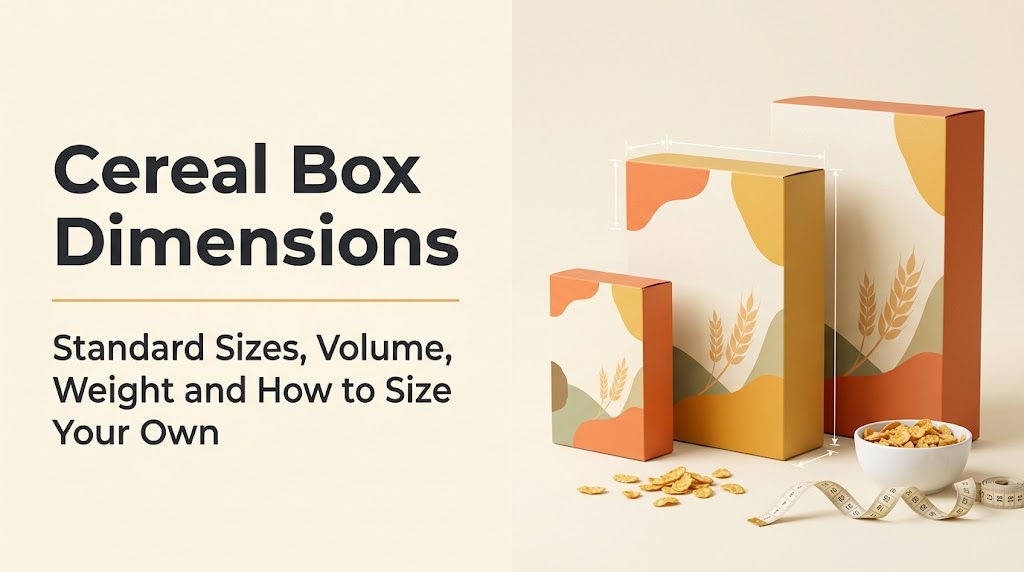
A cereal box looks simple until you have to order one. Order it 1/4″ too deep and you pay for air and ship cartons that look half empty. Order it too shallow and the panels bow and the flakes crush. Mix up the dimension order and the supplier builds a box lying on its side.
ZK Print Solutions has printed and packaged for food brands since 1995. This guide gives you the typical cereal box sizes, the math behind them, and a simple method for sizing a custom printed carton around your own product.
| Quick answer: A standard cereal box is about 12″ tall × 7.5″–8″ wide × 1.75″–2.5″ deep (30.5 × 19–20 × 4.4–6.4 cm) and holds roughly 10–18 oz of cereal. Mini boxes are around 6.5″ tall, and family-size boxes run 13″–15″ tall. Brands vary, so always measure your own product before you order. |
Cereal Box Dimensions at a Glance
These are typical market ranges. Exact sizes differ by brand, product density and retailer requirements, so treat them as a starting point.
| Size | Typical contents | Inches (H × W × D) | Centimetres | Volume |
| Mini / single-serve | 1–2 oz (28–57 g) | 6.5″ × 4″ × 1.5″ | 16.5 × 10.2 × 3.8 cm | 39 in³ (639 cm³) |
| Standard | 10–18 oz (283–510 g) | 12″ × 7.5″–8″ × 1.75″–2.5″ | 30.5 × 19.1–20.3 × 4.4–6.4 cm | 158–240 in³ (2,581–3,933 cm³) |
| Family / large | 18–24 oz (510–680 g) | 13″–15″ × 8″ × 2.5″–3.5″ | 33–38.1 × 20.3 × 6.4–8.9 cm | 260–420 in³ (4,261–6,883 cm³) |
Volume is simply height × width × depth. A 12″ × 8″ × 1.75″ box is 12 × 8 × 1.75 = 168 cubic inches (about 2,753 cm³). Change the depth to 2.5″ and the same box jumps to 240 cubic inches.
How Tall Is a Box of Cereal? Height, Width and Depth Explained
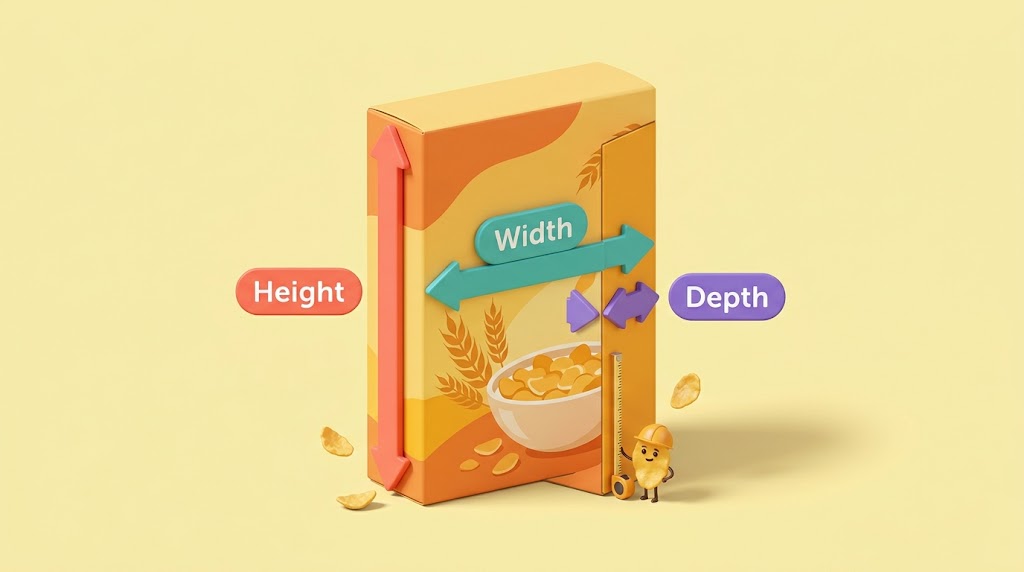
Height
About 12 inches (30.5 cm) for a standard box. Height is the most consistent measurement across brands because it is driven by shelf spacing and case packing. Family and bonus sizes grow mostly in height and depth, not width.
Width
Between 7.5″ and 8″ (19–20 cm) for most standard boxes. Width is your front panel, so it controls how much brand space you get at eye level on the shelf.
Depth
Usually 1.75″ to 2.5″ (4.4–6.4 cm). Depth is the measurement people overlook. Too shallow and the side panels bow outwards and crush the product. Too deep and you waste board, shelf space and shipping volume.
Mini and Single-Serve Cereal Box Sizes
Mini boxes are about 6.5″ × 4″ × 1.5″ and hold roughly 1–2 oz. Brands use them for sampling, hotel and travel breakfasts, variety packs and lunchbox sizes. They also work well for limited-edition and seasonal runs, such as our Halloween special range.
Family-Size Cereal Box Dimensions
Family-size boxes keep the 8″ width so they still fit the shelf facing, then add height and depth. Expect roughly 13″–15″ tall and 2.5″–3.5″ deep for 18–24 oz. Always confirm against a measured sample, because brands label “family”, “giant” and “mega” differently.
Cereal Box Weight and Capacity
| Box size | Cereal weight | Approx. servings | Notes |
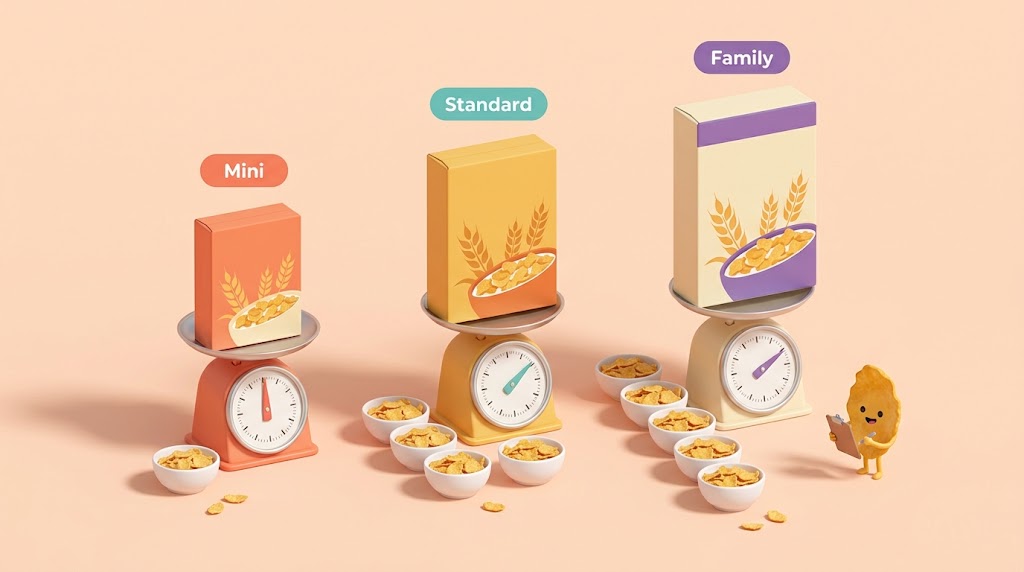
| Mini | 1–2 oz (28–57 g) | 1 | Single portion |
| Standard | 10–18 oz (283–510 g) | about 8–15 | Depends on serving size |
| Family | 18–24 oz (510–680 g) | about 15–22 | Larger boxes use thicker board |
A light cereal serving is roughly one cup, or about 28–40 g, so a 12 oz (340 g) box holds around 8–12 servings. Denser products such as granola and muesli pack much heavier into the same volume. That is why box size should be set by your product, not by a competitor’s carton.
How to Read Carton Dimensions Before You Order (L × W × D)
Here is the mistake that causes the most reprints. Retail shoppers describe a cereal box as height × width × depth. Packaging suppliers usually describe a carton by its opening:
• Length: the longer side of the top opening.
• Width: the shorter side of the top opening.
• Depth (height): how tall the carton is.
So a 12″ tall cereal box with an 8″ × 2″ top is ordered as 8 × 2 × 12, not 12 × 8 × 2. Always confirm which convention your supplier is using. Our guide to length, width and height box dimensions walks through it with diagrams.
How to Calculate the Right Size for Your Own Cereal Box
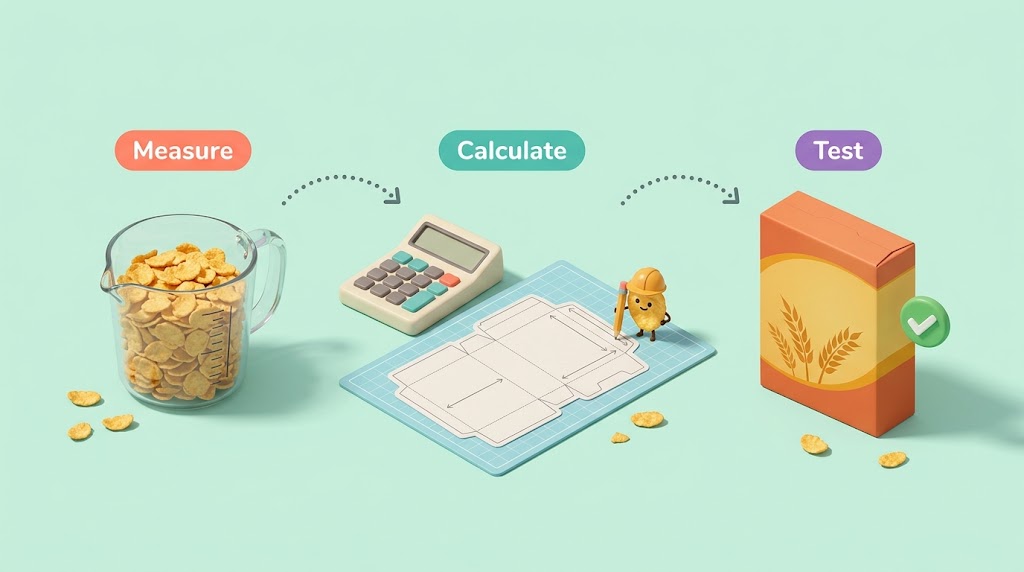
1. Measure your product volume. Pour a real batch into a measuring jug and note the volume in mL, after a few taps so it settles.
2. Set a fill ratio. Divide by a fill ratio of about 0.85–0.90 as a starting point. This allows for the inner bag and its folded top. Test and adjust.
3. Fix width and height first. Choose width for shelf facing (7.5″–8″) and height for shelf and case fit.
4. Solve for depth. Depth = inner volume ÷ (height × width). Convert units first: 1 cubic inch = 16.39 mL.
5. Allow for board thickness. Folding carton board is typically 16–24 pt (0.016–0.024″), so outer dimensions are slightly larger than inner ones.
6. Test-fill and ship a sample. Check the fill level, the panel bow and how the box survives a case drop before approving the print run.
Worked Example
| Step | Result |
| Product: 340 g (12 oz) flaked cereal | Settled volume measured at 3,100 mL |
| Fill ratio 0.90 | 3,100 ÷ 0.90 = 3,444 mL = about 210 in³ |
| Inner height 11.5″, inner width 7.5″ | Depth = 210 ÷ (11.5 × 7.5) = about 2.4″ |
| Add board thickness | Outer size around 12″ × 7.75″ × 2.5″ |
This is an illustration. Your real numbers depend on your cereal’s density and liner. Send us a sample and our team will do the test-fill and confirm the size for you.
Anatomy of a Cereal Box: Panels, Flaps and Where Things Go
Most cereal cartons are tuck-end folding cartons. Knowing the panels helps you plan artwork and avoid dieline errors.
• Front panel (principal display panel): brand, product name, hero image and net weight.
• Side panels: commonly the Nutrition Facts and ingredient list.
• Back panel: storytelling, recipes, promotions, barcode.
• Top and bottom flaps: tuck-in closures. Not sure about the style? Read what is a tuck box.
• Glue flap: the narrow strip that forms the side seam. Keep artwork and text clear of it.
| Labeling note: In the US, food packaging has specific rules for the front panel, net quantity statement, Nutrition Facts and allergen declaration. This guide is general packaging advice, not legal advice. Check your artwork with your food compliance advisor before printing. |
Materials and Liners: Keeping Cereal Fresh and Unbroken
Outer Box Board
Most cereal cartons use SBS paperboard for crisp printing, or kraft board for a natural look. See our full range in food packaging, and our eco-friendly packaging options if recyclable or recycled board matters to your brand.
Inner Liner
The outer carton gives structure and branding, but the inner liner is the main barrier against moisture and staleness. Wax-coated paper, poly and recyclable liners are all used. If you sell granola, muesli or loose-leaf blends, a pouch may suit you better than a carton, so compare our mylar bags, food storage mylar bags and resealable mylar bags.
Cereal Boxes vs Bakery Boxes: Why the Sizes Differ
Cereal boxes are tall and shallow because they are built for supermarket shelving and light, brittle flakes. Bakery boxes are shorter and wider, often with a window, because they hold delicate items that customers want to see. If your range includes both, browse our bakery boxes, custom cake boxes and bakery and sweet packaging. Snack lines can pair with custom popcorn boxes for a matching look.
5 Cereal Packaging Pain Points (and How to Avoid Them)
1. Wrong Dimension Order on the Purchase Order
Confirm the convention in writing and approve a dieline with dimensions marked on it. A two-minute check avoids a reprint.
2. Oversized Boxes and Visible Empty Space
Excess empty space (slack-fill) raises shipping cost, wastes board and can draw customer complaints. Size from your measured product volume, not from a competitor’s box.
3. Crushed Cereal in Transit
Retail cartons are not shipping boxes. Pack finished cartons in sturdy outer cases such as our E-flute corrugated boxes and test a full case drop before launch.
4. Stale Cereal and Soft Flakes
Specify the liner as carefully as the carton, and make sure its size matches your box width and height.
5. Artwork That Doesn’t Fit the Panels
Place regulated text on the right panels, keep it clear of folds and glue flaps, and approve our 3D proof before printing. Launching a small batch first? Put custom cereal labels on plain cartons while you test the market, then move to full printed boxes. Our labels and stickers also work as tamper-evident seals.
Make Your Cereal Stand Out on the Shelf and the Counter
Packaging is the first thing a shopper judges. Choose display boxes or counter display boxes for retail, and read how display boxes boost retail visibility. For design inspiration, see our post on cereal mascots and packaging lessons, and why your choice of custom packaging boxes matters. Browse our full range of custom packaging for matching cartons, sleeves and gift sets.
Why Brands Choose ZK Print Solutions
ZK Print Solutions brings custom printing, packaging and branding under one team, with experience since 1995. What that means for your cereal packaging:
• Free design support and free 3D mock-ups before production.
• Digital proofs you approve first, so nothing prints without your sign-off.
• Custom sizes and materials, including kraft, white board and food-grade options.
• Real feedback: customers rate us 4.9 on Google and 4.7 on Trustpilot.
Frequently Asked Questions About Cereal Box Dimensions
How tall is a box of cereal?
A standard cereal box is about 12 inches (30.5 cm) tall. Mini boxes are around 6.5 inches, and family-size boxes are roughly 13 to 15 inches.
What are the dimensions of a standard cereal box?
Typically 12″ tall × 7.5″–8″ wide × 1.75″–2.5″ deep (30.5 × 19–20 × 4.4–6.4 cm). Brands vary.
What is the volume of a cereal box?
A 12″ × 8″ × 1.75″ box has a volume of 168 cubic inches (about 2,753 cm³). With a 2.5″ depth it is 240 cubic inches (about 3,933 cm³).
How much does a box of cereal weigh?
Standard boxes hold about 10–18 oz (283–510 g) of cereal. Family sizes hold about 18–24 oz (510–680 g). The packaging adds a little more.
Do cereal boxes need an inner liner?
Most do. The liner is the main moisture barrier, while the carton provides structure and branding.
Can I order a custom cereal box size?
Yes. Custom sizes, materials and finishes are available. Send us your product or its volume and our team will recommend the dimensions.
Ready to Get Your Cereal Box Size Right the First Time?
The right dimensions protect your product, keep shipping costs down and make your brand look professional on the shelf. The wrong ones cost you in reprints, waste and returns.
At ZK Print Solutions, our team will confirm your dimensions, material and liner, then show you a free 3D proof before anything is printed. Ready to start? Get a free quote, message us on WhatsApp or contact our team, and we’ll come back with a size recommendation and pricing for your cereal packaging.